Proof Over Precedent

Proof Over Precedent is a weekly podcast discussing the work of bringing credible evidence to lawyers, judges, and decision makers, to transform the U.S. justice system into an evidence-based field. Listeners will learn from one-on-one interviews with experts in the area of access to justice–researchers, lawyers, professors, law students, data analysts, research participants, and anyone who has an interesting role in this growing area.

Cartoon depicting an "expungement party" with a blindfolded donkey playing "pin the expungement", showing the challenges associated with obtaining an expungement

Episode 52: Study Exposes Complex Criminal Record Clearing Process

Is the form-filling expungement process as easy for unrepresented individuals as some believe? In this week’s Proof Over Precedent episode, host Jim Greiner welcomes the A2J Lab team involved in our long-running Kansas-based study looking at the current record-clearing process and its obstacles. The results offer clear evidence for what it takes for a successful expungement.

Cartoon depicting a lawyer helping a tenant navigate an eviction hearing

Episode 51: How Lawyers and Rental Assistance Impact Eviction Cases

Facing an eviction, a tenant has to decide if the added expense of an attorney is worth it for the possibility of avoiding an eviction judgment. In a discussion of a randomized controlled trial outside the A2J Lab, Faculty Director Jim Greiner talks with economists Aviv Caspi and Charlie Rafkin about when, why, and whether lawyers make a difference in evictions cases. The study coincided with a government emergency housing fund that expired during the RCT, which helped answer how lawyers can best make a difference as well.

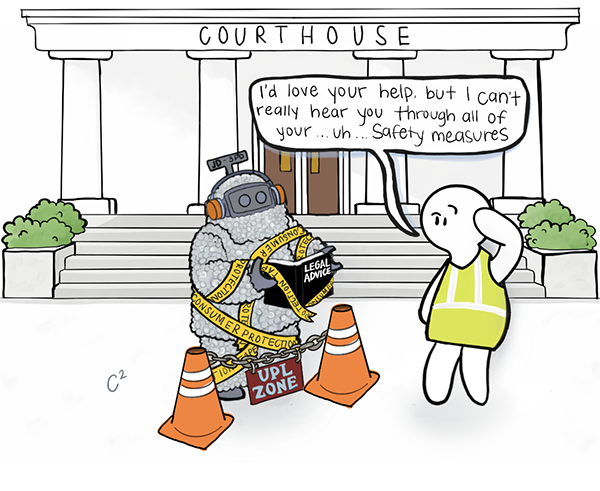
Cartoon depicting a pro se litigant seeking help from AI, but AI is literally tied up in caution tape from UPL regulations

Episode 50: Pro Se Litigants, AI, and the Future of Legal Assistance

State bar associations typically file more UPL complaints than consumers. Given the intended aim of protecting consumers, UPL may actually be serving more as an obstacle and less as a protection for consumers using generative AI in the legal space. That’s the argument Wake Forest Law Professor and UPL expert Ellen Murphy makes in the latest Proof Over Precedent episode, where she identifies the legal industry’s progress with AI regulation by state and how AI and human counseling may combine to be the strongest access-to-justice resource.

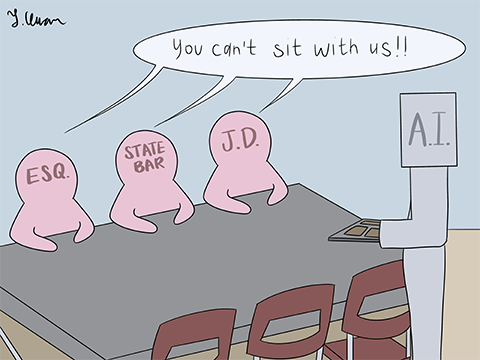
Cartoon depicting AI as a robot not allowed to sit at the lunch table with the lawyers, J.D. candidates, and bar associations.

Episode 49: AI and the Future of Legal Aid—Navigating Unauthorized Practice

The low cost and accessibility of AI make it a potential game changer for pro se litigation and the future of affordable legal aid. But with the patchwork of state unauthorized practice of law (UPL) rules and no court resolution on AI’s UPL liability, it also faces an uncertain future as a legal tool. HLS students tackle the issue in the latest Proof Over Precedent and distinguish between legal information and legal advice—a key to general-purpose AI’s future in law.

Cartoon depicting the bar as autos being allowed through an intersection in which a truck labeled as an auto club must stop.

Episode 48: Legal Evolution from Auto Clubs to Access Barriers

When the organized bar association faced financial strain during the Depression, it cracked down on low-cost legal service providers via auto clubs like AAA, contributing to today’s access-to-justice gap. In this “How did we get here?”-style episode, HLS student Andrew Reed interviews Stanford Professor Nora Freeman Engstrom and University of Chicago Fellow James Stone about their research and the “revolution” taking place in many states to reform the legal profession.

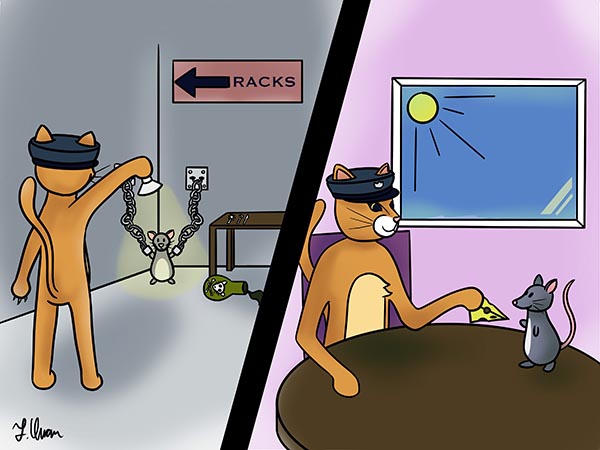
Cartoon depicting a police officer as a cat shining a light on a mouse chained in a room vs. cat in a window-lit room giving a mouse a piece of cheese at a table.

Episode 47: How Does Interrogation Room Design Impact Legal Outcomes?

How likely would you be able to answer questions under duress seated in a hard chair in a windowless, flourescent-lit box of a room? What about in a larger space with natural lighting and comfortable seating? In this episode of Proof Over Precedent, HLS student Spencer Thieme discusses interrogation rooms and the effect of a physical environment on stress, memory, disclosure, and false confessions. She also considers potential randomized controlled trials for studying interrogation room design.

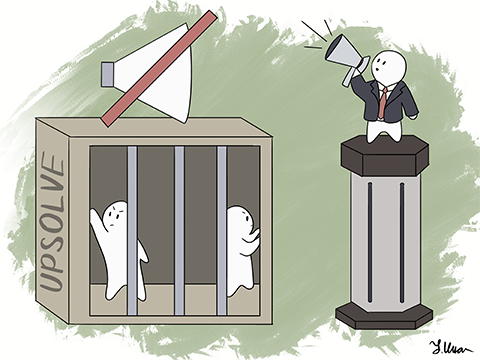
Cartoon depicting Upsolve in jail without a way to communicate while New York courts stand tall with a megaphone in hand

Episode 46: Upsolve in Depth—When does Legal Advice Become Illegal?

The role of trained nonlawyer volunteers is at the center of a back-and-forth court case between nonprofit Upsolve, Inc. and Letitia James, attorney general of the state of New York. This “Student Voices” episode tackles both the access to justice issues at stake for indigent defendants in debt collection cases, as well as New York’s unauthorized practice of law statute governing the decision(s), including the most recent ruling by the New York District Court in March.

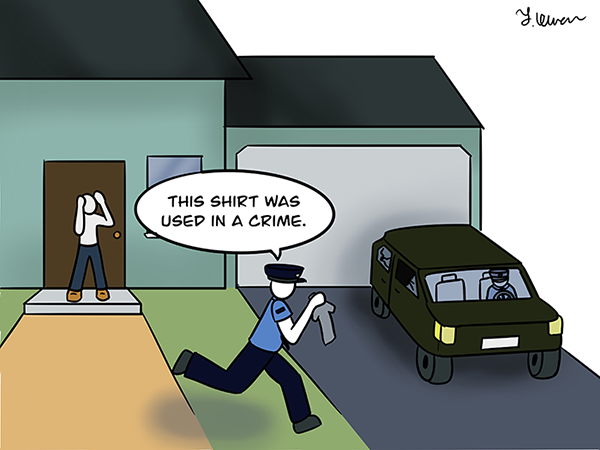
Cartoon depicting a police officer taking the shirt off of an individual's back and declaring that it was used in a crime.

Episode 45: Proof and Property—Is Civil Forfeiture a Just Practice?

In this week’s Proof Over Precedent episode, we look at civil forfeiture—law enforcement’s seizing and relinquishing of property based on probable cause in a criminal connection—and the impact it has on individuals, including innocent third-party owners. With no guaranteed right to counsel for these cases, most individuals never challenge forfeitures; the barriers are simply too high. Limited research means the practice of civil forfeiture is ripe for a study that goes beyond its impact on potential for future crime and expands to due process.

Cartoon depicts inmate waiting to be admitted into a virtual child welfare hearing

Episode 43: Navigating Child Custody Challenges From Behind Bars

This week’s “Student Voices” episode of Proof Over Precedent explores access to justice issues for incarcerated parents in the child welfare system. HLS student Mia Robertson looks at the process of removing a child from a home, working toward permanent placement and/or reunification, and the numerous barriers an incarcerated parent faces in custody cases, from an inability to show up for in-person hearings to a lack of reliable communication with an attorney (if they have counsel representation at all).

Scroll to Top