Proof Over Precedent

Proof Over Precedent is a weekly podcast discussing the work of bringing credible evidence to lawyers, judges, and decision makers, to transform the U.S. justice system into an evidence-based field. Listeners will learn from one-on-one interviews with experts in the area of access to justice–researchers, lawyers, professors, law students, data analysts, research participants, and anyone who has an interesting role in this growing area.

Cartoon depicting a judge smashing a laptop in which a Zoom meeting took place.

Episode 68: Evaluating Procedural Fairness in Court and on Zoom

Self-represented litigants primarily measure procedural justice by whether they had a voice, were listened to, and were treated fairly in court. Do these basic marks of overall satisfaction differ between the mode in which the hearing took place though? This week’s Proof Over Precedent episode features an interview with justice reform consultant Emily LaGratta and Nathanael Player, former director of the Utah State Court Self-Help Center, about a study looking at litigants’ perception of fairness in their respective experiences with either remote or in-person court.

Cartoon depicting a dust bunny from "Death-Kwal Air Filter" handing out a jury slip to a worried individual trying to run away from it.

Episode 67: Capital Jury Selection’s Hidden Biases

Serving as a juror fulfills one’s civic duty to ensure a system of checks and balances in the U.S. In capital cases, however, “death qualification” ensures that prospective jurors opposed to the death penalty will not have the opportunity to perform this civic duty. This week’s Proof Over Precedent episode features a “Student Voices” interview with Megan Byrne of the ACLU’s Capital Punishment Project to discuss the shortcomings of less diverse juries due to race, gender, and religious differences. It also looks at a capital case in Kansas in which the courts examined the problems associated with death qualification and the death penalty overall.

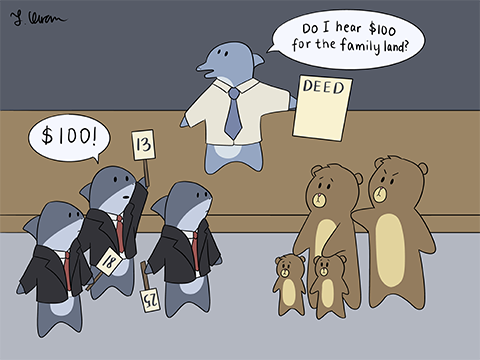
Cartoon depicting an auctioneer selling off family land for $100, with a family of bears looking on while sharks in suits bid on the land.

Episode 66: Heirs’ Property’s Fragile Hold on Land Ownership and Justice

Just because an individual may own property, does not guarantee that the person may keep that property—that’s the warning stemming from this week’s podcast episode featuring an interview with Dr. Kara Woods, research analyst at Alcorn State University’s National Policy Research Center. Issues may arise from heirs property—co-owned land in which the name of the original, and now deceased, owner is still on the deed. Land loss due to heirs property issues affects groups disproportionately by race and class, and the policy protections against it are inconsistent across states. The ensuing legal hurdles mark a barrier that some families cannot overcome. One takeaway: Communicate with your family members!

Cartoon depicting an inmate with paper court filings at the door of a Supreme Court courthouse with the doors closed and a sign on the door reading "Martinizing"

Episode 65: Access vs. Efficiency—Supreme Court Weighs Frivolous Filings

“Martinizing”, the controversial Supreme Court practice of denying court fee waivers for indigent litigants, is meant to reduce frivolous filings, but at what cost? This episode looks at the January 2026 Howell order in which Justice Ketanji Brown Jackson was the sole dissenting voice against Martinizing indigent prisoners. Her argument reignites the perspective that access to justice and the potential for future meritorious claims should outweigh workload relief.

Cartoon depicting a sign pointing up a long path to Court (10-hour line) vs a sign pointing to a desk with a robot indicating a 5-minute AI decision

Episode 64: Can AI Resolve Brazil’s Judicial Backlog?

More than 100 million pending cases await Brazil courts, so it may not be surprising that the country’s Supreme Court Justice has a reportedly rosy view of AI in the court system, especially in time-sensitive civil and criminal matters. The potential for AI to help alleviate the backlog and potentially bring more balance and less bias may brush over the possible system errors and human rubber-stamping that come with it. This “Student Voices” podcast discusses Brazil’s use of AI in the court system and the areas ripe for more scrutiny–evaluations through RCTs and metric-based learning models.

Cartoon depicting a businessman divided in half. One side is "Asset Co.", with him saying "I'm rich!", while the other half is Liability Co. claiming "Sorry, I'm bankrupt."

Episode 63: Texas Two-Step Bankruptcy–Corporate Restructuring or Legal Loophole?

The Texas Two-Step is a fairly simple dance, but in the world of corporate bankruptcy, it’s the name of a sophisticated maneuver that some profitable companies employ to stop mass tort liabilities and limit the settlements due to victims. It splits a company and strategically divides its assets and liabilities. In this manner, the companies win and the tort victims, by comparison, lose. But there may be reason for cautious optimism. Proof Over Precedent interviews bankruptcy scholar and law professor Melissa Jacoby about the practice, the reasons courts allow it, and the avenues under consideration for making bankruptcy a more just and exceptional option for corporations.

Cartoon depicting a judge as the outer layer of stacking dolls with a robot as one of the inner dolls.

Episode 62: Navigating Immigration Law Post-Trump v. CASA

Trump v. CASA did not directly address immigration and birthright citizenship when it ruled against universal injunctions, and yet…The aftermath of the ruling left the immigration law landscape in a tailspin. This week’s Proof Over Precedent episode interviews Katie Taylor, Legal Director of the Neighbors Immigration Clinic (Lexington, KY), where the practice has shifted its role now that the state houses eight immigration detention centers. She provides a frontline view of the scramble that immigrants and the clinics supporting them face without nationwide relief.

Cartoon depicting "Blob" moving a stage curtain with a picture of a confident judge and seeing the actual judge behind the curtain looking concerned.

Episode 61: The Promise and Pitfalls of Active Judging

Pro se litigants have reason to hope for a better civil courtroom experience with active judging. If done right, this reform promises more clarity and mercy for those unfamiliar with legal procedures, and better fact-finding and balanced evidence for judges overseeing the cases. This week’s Proof Over Precedent episode discusses the potential for reform, what’s holding judges back from fully adopting it, and the procedural and legislative changes necessary to support both judges and pro se litigants in fairer, more efficient civil hearings.

Cartoon depicting ants triaging wounded ants while a judge dictates how medical cases will be prioritized

Episode 60: Beyond Gideon—Rethinking Access to Justice

Is it time for an inquisitorial legal system? How about a redesigned “lawyer-less” court? This isn’t the wild west of the legal world, but rather a lively discussion among three access to justice advocates on the merits–or rather shortcomings–of a push for a civil right to counsel and possible alternatives to closing the access to justice gap. Join Law Professor Benjamin Barton (University of Tennessee), The Honorable Stephanos Bibas of the U.S. Court of Appeals for the Third Circuit, and our own A2J Lab director and Harvard Law School Professor Jim Greiner in this week’s Proof Over Precedent episode.

Episode 59: Legal Aid on the Front Line of Immigration

When it comes to immigration, the legal aid sector has pivoted its resources from affirmative relief for immigrants to defense deportation and detention center intakes. In this “Student Voices” podcast, the discussion between fellow Harvard Law School J.D. candidates Andrew Garcia and Emily Irigoyen, the latter of whom co-leads the Harvard Immigration Project, ranges from the fallout of this shift in immigration legal aid resources to the shortcomings of typical immigration proceedings and the need for family preparedness planning.

Scroll to Top