Proof Over Precedent

Proof Over Precedent is a weekly podcast discussing the work of bringing credible evidence to lawyers, judges, and decision makers, to transform the U.S. justice system into an evidence-based field. Listeners will learn from one-on-one interviews with experts in the area of access to justice–researchers, lawyers, professors, law students, data analysts, research participants, and anyone who has an interesting role in this growing area.

Cartoon depicting a judge as the outer layer of stacking dolls with a robot as one of the inner dolls.

Episode 62: Navigating Immigration Law Post-Trump v. CASA

Trump v. CASA did not directly address immigration and birthright citizenship when it ruled against universal injunctions, and yet…The aftermath of the ruling left the immigration law landscape in a tailspin. This week’s Proof Over Precedent episode interviews Katie Taylor, Legal Director of the Neighbors Immigration Clinic (Lexington, KY), where the practice has shifted its role now that the state houses eight immigration detention centers. She provides a frontline view of the scramble that immigrants and the clinics supporting them face without nationwide relief.

Cartoon depicting "Blob" moving a stage curtain with a picture of a confident judge and seeing the actual judge behind the curtain looking concerned.

Episode 61: The Promise and Pitfalls of Active Judging

Pro se litigants have reason to hope for a better civil courtroom experience with active judging. If done right, this reform promises more clarity and mercy for those unfamiliar with legal procedures, and better fact-finding and balanced evidence for judges overseeing the cases. This week’s Proof Over Precedent episode discusses the potential for reform, what’s holding judges back from fully adopting it, and the procedural and legislative changes necessary to support both judges and pro se litigants in fairer, more efficient civil hearings.

Cartoon depicting ants triaging wounded ants while a judge dictates how medical cases will be prioritized

Episode 60: Beyond Gideon—Rethinking Access to Justice

Is it time for an inquisitorial legal system? How about a redesigned “lawyer-less” court? This isn’t the wild west of the legal world, but rather a lively discussion among three access to justice advocates on the merits–or rather shortcomings–of a push for a civil right to counsel and possible alternatives to closing the access to justice gap. Join Law Professor Benjamin Barton (University of Tennessee), The Honorable Stephanos Bibas of the U.S. Court of Appeals for the Third Circuit, and our own A2J Lab director and Harvard Law School Professor Jim Greiner in this week’s Proof Over Precedent episode.

Episode 59: Legal Aid on the Front Line of Immigration

When it comes to immigration, the legal aid sector has pivoted its resources from affirmative relief for immigrants to defense deportation and detention center intakes. In this “Student Voices” podcast, the discussion between fellow Harvard Law School J.D. candidates Andrew Garcia and Emily Irigoyen, the latter of whom co-leads the Harvard Immigration Project, ranges from the fallout of this shift in immigration legal aid resources to the shortcomings of typical immigration proceedings and the need for family preparedness planning.

Cartoon depicting both worker unions and worker centers as ballerinas. The "union" ballerina asks the "worker center" ballerina how she got so flexible.

Episode 58: Labor Innovations Bridge Access-to-Justice Gap for Immigrants

Labor movements have had to get creative when it comes to labor justice for immigrant workers. That’s where worker centers fill the niche not covered by traditional labor unions. In this Proof Over Precedent episode, HLS Professor Sharon Block, executive director of the Center for Labor and a Just Economy, discusses the difference between the two labor organizations, the future of the two, and the vital role collective action plays in advocating for justice.

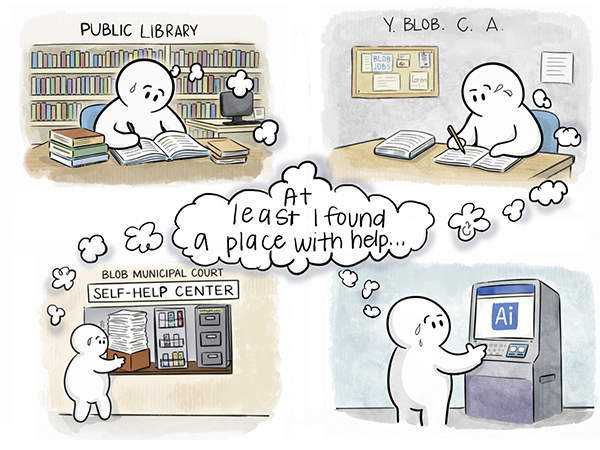
Cartoon depicting Blob accessing AI legal help from various publicly accessible locations--library, municipal court self-help center, community centers, and 'AI terminals'.

Episode 57: Libraries and AI—Partners for Accessible Justice?

In this “Student Voices” episode, HLS student Grace Gao interviews Ari Scourtas, Product and Research Manager of the Library Innovation Lab at Harvard Law School, about making AI legal tools accessible for people facing digital barriers. The discussion covers legal AI’s risks and opportunities for self representation and the expanding role libraries play in bridging the knowledge gap around AI.

Cartoon depicting a scale measuring the Law Enforcement Officer Bill of Rights, with public accountability being outweighed by police protections.

Episode 56: The Conflicting Sides of Police Procedural Protections

This bonus episode of Proof Over Precedent looks at the access to justice issues around the Law Enforcement Officer Bill of Rights (LEOBR) statutes and contract provisions that grant police officers enhanced procedural protections during internal misconduct investigations. At odds are the tensions between public accountability and officers’ claims of needing protection from false accusations. HLS student Strong Ma proposes a randomized controlled trial to study the effects on investigation outcomes, civil litigation, and perceived fairness.

Cartoon depicting a Reclamo robot protecting a worker from a robber stealing worker wages

Episode 55: Navigating Workplace Justice Through an AI Lens

Workplace justice issues take center stage in this Proof Over Precedent “student voices” episode focused on Reclamo AI, an AI chatbot, developed to help workers–especially immigrant communities — address wage theft and find local advocates. Joshua Medina, legal director for Pro Bono Net’s JusticiaLab, shares insight on the transformation of the tool, including its efforts to protect user privacy and to avoid unauthorized practice of law.

Cartoon depicting the aftermath of an expungement party in which the individual does not feel better after obtaining an expungement order

Episode 54: Will Clearing a Criminal Record Lead to Happiness (and Housing)?

“My criminal record doesn’t reflect who I am anymore.”
This sentiment overwhelmingly topped the list of reasons why expungement study participants wanted to clear their record that it seemed plausible to predict that clearing one’s criminal record would lead to higher levels of life satisfaction. Likewise, it did not seem far-fetched to assume individuals without a criminal record would fare better in obtaining housing than those with one. In both cases though, the A2J Lab and Kansas Legal Services found surprising results to refute these assumptions.

Cartoon depicting two individuals at an expungement party discussing how one can't find a job and the other is dissatisfied at the same job.

Episode 53: Expungement Expectations vs. Reality in Employment

The A2J Lab’s randomized control trial on expungement examined the uptake and obstacles of criminal record clearing while also looking into its effect on various socio-economic outcomes. This week’s Proof Over Precedent episode gathers study researchers to discuss the “surprising and depressing” findings on expungement’s effect on employment. They also dive into explanations for the stark difference between individuals’ optimism and reality in the experiment.

Scroll to Top