

By Eric Krebs, J.D. candidate, Harvard Law School
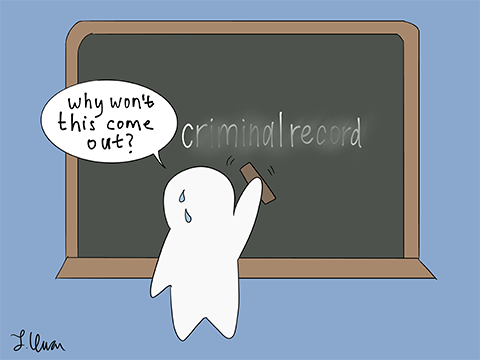
An estimated 70 to 100 million American adults—roughly one in three—have criminal records. Those records can pose substantial barriers to employment, even when charges never result in convictions. Employers routinely conduct background checks, and studies have found lower callback rates for applicants with criminal histories. In response, states have expanded laws that seal records or restrict their disclosure, promising people a fresh start.
But does removing a record from an employer’s view actually improve employment prospects? And can it undo damage that has already occurred?
In an episode of Proof Over Precedent, host Jim Greiner, faculty director of the Access to Justice Lab and the Honorable S. William Green Professor of Public Law at Harvard Law School, spoke with Amanda Agan, Professor of Economics at Cornell University, and Crystal Yang, Professor of Public and International Affairs at Princeton University. Along with Andrew Garin, Dmitri Koustas, and Alexandre Mas, they coauthored “Can You Erase the Mark of a Criminal Record? Labor Market Impacts of Criminal Record Remediation,” a study examining the employment consequences of policies that restrict access to criminal records.
The findings were sobering: across three policies, the researchers detected little improvement in conventional employment outcomes for the average affected person.
Agan’s interest grew out of earlier research on “Ban the Box” laws, which bar criminal history questions on initial job applications. Her audit study found that the policies could backfire. Unable to distinguish applicants with records from those without, employers appeared to rely more on racial stereotypes. Callback rates declined for Black applicants overall, including those without criminal records. As Agan put it, employers “stereotype them as likely to have a criminal record, whether they do or not.”
And employers could still conduct background checks later. What if the information never reached them in the first place?
The researchers examined three approaches. The federal Fair Credit Reporting Act generally prevents consumer reporting agencies from reporting non-conviction charges more than seven years old for jobs paying less than $75,000 annually. Maryland restricts reporting older convictions for certain lower-paying jobs. Pennsylvania’s 2018 Clean Slate Law goes further, automatically sealing eligible non-conviction records and some older low-level convictions. Unlike petition-based expungement, automatic sealing does not require individuals to discover their eligibility and apply for relief.
To evaluate these policies, the researchers linked court records from Maryland, New Jersey, Pennsylvania, and Bexar County, Texas, to IRS employment and earnings records. For federal and Maryland reporting limits, they examined whether employment trends changed when old records became unreportable. In Pennsylvania, they compared individuals whose records were automatically sealed with those initially excluded because they owed court fines and fees.
That comparison helped account for a major complication: the sealing program coincided with the COVID-19 pandemic. Employment fell for both groups, and sealing did not appear to soften that decline.
The study was not a randomized trial. Its quasi-experimental methods seek to estimate the effects of record-remediation policies but depend on assumptions about what would have happened without them. The Pennsylvania groups, for example, may differ in ways beyond unpaid fees. Still, across the three approaches, the researchers found no detectable average improvement in formal employment.
Their principal seven-year analysis was precise enough to rule out relatively small changes: the 95% confidence intervals excluded employment increases exceeding 0.2 percentage points in year seven and 0.4 points in year eight, relative to the preceding trend.
There was, however, one exception: work through online gig platforms.
Around the seven-year cutoff, participation roughly doubled, from about 0.3% to 0.6% of the studied population. That is a large relative gain, but a modest one in absolute terms. The paper notes that the pattern was largely driven by convictions, suggesting some platforms may themselves apply seven-year screening rules even where the federal statute does not require it.
Why might gig work respond when traditional employment does not? The researchers point to “scarring.” A criminal charge may coincide with job loss or interrupted career development. Even if the record later disappears from a background check, an employer may still see gaps in the applicant’s résumé or a history of unstable jobs. As Agan explained, “You might not see the criminal history per se,” but employers still see a potentially less attractive employment history.
Gig platforms, by contrast, generally focus less on résumés and more on whether applicants pass screening requirements. The positive finding is thus consistent with scarring—but does not prove it. The study documents employment declines around criminal charges; it cannot establish how much of those declines the charges themselves caused, rather than other events occurring at the same time.
Timing may be crucial. The Pennsylvania analysis, restricted to young adults, included records at least 18 months old, but could not study immediate sealing upon dismissal. That possibility remains untested. And a lack of measurable employment gains does not rule out benefits for housing, civic participation, or quality of life.
The larger lesson is not that record clearing is pointless. It is that concealing a record may be easier than reversing the consequences of criminal-justice involvement. Researchers still need to determine whether earlier relief—or other interventions—can change a person’s trajectory before the damage becomes lasting. As Yang put it, the goal remains “trying to find something that works.”
If you’re interested in more on this topic, listen to our podcast episode.