

By Ashil Jhaveri, J.D. Candidate, Harvard Law School
STUDENT VOICES: The views expressed below are those of the student author and do not necessarily reflect the position of the Access to Justice Lab.
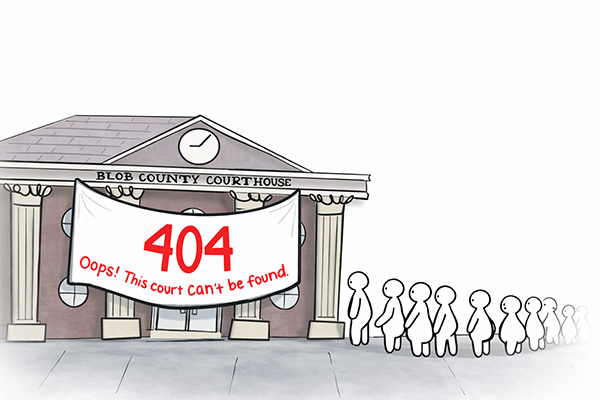
America’s judicial system faces a cybersecurity crisis. Decades of underinvestment, decentralized architecture, over-reliance on third parties, organizational inefficiencies, and the absence of binding standards have crippled courts, delayed cases, and cost taxpayers millions. Effective cybersecurity promotes access to justice by giving litigants reason to trust the integrity of the judicial system. Court technology “is the means by which Judges and Judiciary staff do their job.” Without effective cybersecurity, there can be “significant effects on national security, the economy, community safety, and even confidence in the integrity and strength of the courts and broader federal government,” according to Judge Michael Scudder, chair of the federal judiciary’s Information Technology Task Force. This post outlines structural and policy reasons behind courts’ vulnerabilities at the state/local and the federal level; explains why improving cybersecurity improves access to justice; and proposes a few solutions.
State and Local Vulnerabilities
At the state and local levels, courts are struggling against an escalating barrage of cyberattacks. State and local courts have contended with multiple different types of attacks including doxing of judicial personnel, double extortion ransomware, hack-and-leak operations, Distributed Denial of Service (DDoS) attacks, and phishing attacks.
These attacks can grind court operations to a halt. In October 2023, a ransomware attack on the Kansas state court system rendered the judiciary’s case management system inoperable for over a month, disrupting operations across more than 100 counties. In July 2024, another ransomware attack forced the Los Angeles County Superior Court to close all 36 of its courthouses. Similar attacks have plagued courts in Texas, Alaska, Pennsylvania, Georgia, Missouri, Florida, Mississippi, Colorado, and Ohio.
State court cybersecurity vulnerabilities are often the result of chronic underfunding and understaffing. Today, only about two percent of state court budgets nationally go to capital improvements, technology, and innovation, putting much-needed upgrades out of reach. A 2022 survey found that the number of dedicated cybersecurity managers in state and local courts had fallen between 2017 and 2021. Just 60% of court officials said they were conducting annual vulnerability and threat assessments of their IT systems. A 2025 survey found that 22% of respondents were “not at all confident” in the security of their IT systems, although 57% felt highly confident.
Another common challenge, identified in the 2022 survey, is that local courts often lack control over their own systems. They rely on county infrastructure or other government agencies for IT services, leaving the courts without a seat at the table during a crisis.
The Federal System: A System Designed to Fail
While state courts struggle with funding, the federal judiciary faces a crisis of bureaucratic complexity and mismanagement. The problem first became apparent in early 2021 when suspected Russian actors breached the judiciary’s Case Management/Electronic Case Filing (CM/ECF) in the 2020 SolarWinds hack. In response, the Administrative Office of the U.S. Courts (AO) recommended that federal judges accept highly sensitive documents in paper form or via secure, air-gapped devices.
The system remained vulnerable. Around July 2025, suspected Russian actors again breached the CM/ECF system. Evidence suggested multiple nation-states and criminal groups penetrated CM/ECF simultaneously, with at least some of those groups inside the system for years and one of them vacuuming up all data uploaded on CM/ECF every week for months. The hackers accessed documents in cases involving espionage, fraud, money laundering, and foreign agents. “[T]he same rudimentary security issues” that were present since the 2020 hack apparently enabled the breach.
In a letter to Chief Justice John Roberts, Senator Ron Wyden warned the mismanagement of the judiciary’s cyberdefenses constituted a “severe threat to our national security” that could reveal methods to adversaries and enable suspects to flee or target witnesses. These risks are not hypothetical. The federal courts’ collective mismanagement of data has led to hundreds of threatened witnesses and dozens murdered. Authorities fear Latin American drugs cartels are accessing sensitive data to target cooperating witnesses, and the FBI is currently investigating a breach of a system that manages its wiretaps, pen register taps, and other surveillance methods. The threat extends beyond sophisticated nation-states. Recently, a 24-year-old Tennessee man pled guilty to hacking the Supreme Court’s electronic filing system…25 separate times.
Why is the federal system so porous? The answer lies in its federated, decentralized design. CM/ECF dates to the late 1990s and houses 65 million cases with 1.7 billion docket entries. That system is spread across 94 districts and 204 courts, each running its own server instantiation. Because each court manages its own software, the AO cannot roll out universal security patches. Furthermore, the AO lacks the authority to impose binding policies. That power lies with the Judicial Conference, a group of judges that meets twice a year.
Following the 2020 hack, the AO contracted with 18F, the General Services Administration’s tech consulting arm, to study the shortcomings of the CM/ECF system. In its 2021 report, 18F found that many courts develop “local mods” to work around bugs, introducing unique vulnerabilities. Today, there are over 200 versions of CM/ECF built on outdated coding languages where “no one really knows the codebase.” When the AO released the “NextGen” update, nearly 25% of federal courts (52 in total) simply did not upgrade.
To compound the issue, the judiciary is not subject to the minimum federal cybersecurity requirements that executive agencies must follow. While federal agencies have required multi-factor authentication (MFA) since 2015, the AO only recently announced it will require MFA by the end of 2025—and the adopted form isn’t even phishing-resistant.
The Access to Justice Connection
Cybersecurity in the courts is an A2J issue.
When cyberattacks force courts to revert to paper filings and service of sealed documents—as courts in Brooklyn, Manhattan, San Francisco, Miami, and Eastern Virginia did following the 2025 hack—transparency is reduced. In many instances, there are no uniform procedures on how courts might review and unseal documents, or how the public would access documents normally available on PACER.
Many filings are made under time, resource, and other pressures. When e-filing portals are shuttered, even temporarily, people such as domestic abuse victims can be deterred or prevented from submitting their essential documents. Research has shown, for example, that Civil Protection Order Portals can overcome barriers domestic abuse victims face from applying for protection or restraining orders. Kansas is a pioneering state with respect to this technology, but poor cybersecurity could deter filings through the system because of fear the confidential information might be leaked.
Paper filing also introduces the risk of gamesmanship. Opposing counsel can weaponize paper service, claiming delays in the service of sealed documents to gain a tactical advantage. Litigants might lose trust in the integrity of the system. In response to the recent federal breaches, law firms have recommended that clients “take steps to avoid or minimize including sensitive information in court filings.”
When courts are flat funded, paying for emergency cyber fixes harms justice. Last year, Judge Amy St. Eve testified that the judiciary had to reallocate $97 million from salaries, expenses, and Defender services just to fund cybersecurity initiatives. Paying for IT by cutting public defender operations is a blow to indigent defense.
Conversely, secure and modern systems improve access to justice. The Orange County Superior Court recently integrated three disparate systems and 70 million paper files into a single cloud warehouse, improving public accessibility. Similarly, the Alabama Appellate Courts System developed a hybrid cloud solution allowing lawyers to file motions without physically traveling to courthouses. This solution also helps pro se litigants who cannot afford to travel or take time off work to file documents in a courthouse.
Implementing stringent cybersecurity measures can come with access tradeoffs. For example, in response to calls to implement MFA in the federal courts, AO Director Judge Robert Conrad, pointed out that PACER users include journalists as well as indigent, pro se litigants. Implementing strict MFA could inadvertently lock out low-income users who lack access to the traditional devices or applications required for authentication. When the change was ultimately implemented, even well-pocketed law firms struggled, leading to long wait times for support. Increasing friction in accessing court documents drives up costs for legal services, thus hurting access to justice for litigants with limited resources.
Rethinking Courts’ Approach to Technology
To protect national security and ensure equitable access to justice, the judicial system must rethink its approach to technology.
Centralize and Unify Systems: The federated model must end. Alaska’s switch to a unified system was a key advantage in their courts’ ability to respond to and recover from cyberattacks. At the federal level, the 2021 Open Courts Act proposed a blueprint: mandate one public system capable of continual upgrades and built to executive branch cybersecurity standards. While the Judicial Conference opposed the bill over financial concerns, the estimated $260 million price tag over ten years is cheaper than the $298 million, five-year contract the AO recently awarded to sustain the broken legacy system.
Bring Development In-House: An analysis by 18F found that the AO’s departments are “incredibly siloed,” with security split disjointedly between two groups. Current outside contractors are not held to quality standards; they do not include working code as a deliverable, meaning the AO pays for time, not results. Private vendors are incentivized to create “vendor lock-in” where, as one commentator noted, “bad APIs are good business.” Following the 18F’s recommendation, the AO should abandon contractor bids and write software in-house using small, agile teams of 5-7 technologists to ensure interoperable, accountable systems.
Implement Binding Standards: The Judicial Conference should use its policymaking authority to impose binding, minimum cybersecurity standards across all federal courts, eliminating the patchwork of individual court policies. Another option could be delegating the authority to issue binding standards (specifically on cybersecurity) to the AO, which meets more frequently and could respond to crises and vulnerabilities faster.
Regardless of the reforms chosen, courts at all levels of government must recognize that poor cybersecurity leads to more than just administrative inconvenience. Rather, litigants and criminal justice system participants lose access to justice when courts cannot operate in a secure and efficient manner.
If you’re interested in more on this topic, listen to our podcast episode.