

By Ashil Jhaveri, J.D. Candidate, Harvard Law School
STUDENT VOICES: The views expressed below are those of the student author and do not necessarily reflect the position of the Access to Justice Lab.
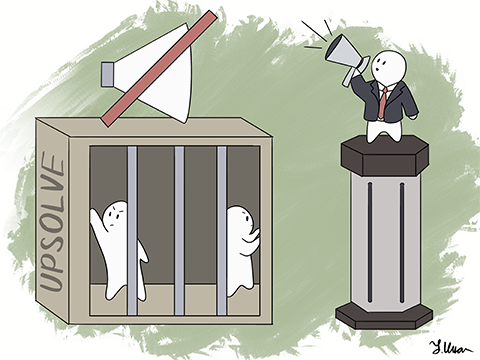
Please note: This blog was written before March 6, 2026, when New York District Court ruled that New York’s UPL statute does survive intermediate scrutiny and dismissed the case of Upsolve, Inc. v. James.
The Second Circuit recently held that intermediate scrutiny, not strict scrutiny, is the correct standard to judge New York’s Unauthorized Practice of Law (UPL) statute as applied to Upsolve, Inc., a nonprofit attempting to create a program in which non-lawyers give limited legal advice to low- income people in debt collection litigation. This blog charts a legal argument Upsolve could use on remand to argue that New York’s UPL statute is still unconstitutional as applied even under the less exacting intermediate scrutiny standard. Upsolve should argue that a total ban on all unlicensed legal advice is over-inclusive, that there is no evidence of tangible harm, and that less restrictive alternatives exist.
Background
Upsolve is a nonprofit founded in 2016. Its primary focus is on assisting people in initiating and completing bankruptcy filings. More recently, it has aspired to help low-income people in New York facing debt collection actions in state court. One major issue in these types of debt collection actions is the high failure-to-appear rate, estimated at 70-90%. When a defendant fails to appear, the court ordinarily enters a default judgment against the defendant. Default allows a credit card company, a debt buyer, a medical care provider, or a bank to win even a clearly meritless claim against a low-income defendant. Assuming the defendant had proper notice of the proceeding, something that does not always happen, the default judgments can lead to wage garnishment, eviction, repossession of an automobile, bank seizure, and lasting damage to a person’s credit score.
To address this access- to- justice issue, New York created a one-page “check-the-box” form that pro se defendants can fill out on their own and return to the court in lieu of appearing. Despite its conciseness, the form is not easy to answer. Questions on the form contain legal terminology that might give a dedicated law student pause. For example, the form has boxes to check if the creditor violated “the duty of good faith and fair dealing”; if “laches” applies; if “the collateral property was not sold at a commercially reasonable price”; or my personal favorite (given I took Civil Procedure with A2J Lab Faculty Director D. James Greiner), if there is “lack of personal jurisdiction.”
Upsolve sought to train non-lawyer volunteers to provide free, individualized advice to pro se defendants on how to fill out the form. Because the volunteers are not lawyers, Upsolve’s program would (if it had ever gotten off the ground) have run afoul of New York’s UPL statute. Before beginning its program, Upsolve sued New York’s Attorney General (AG), seeking a preliminary injunction prohibiting the AG from enforcing New York’s UPL statute against it.
Second Circuit’s Holding
Upsolve argued that applying the UPL statute to its program would violate its First Amendment rights. The United States District Court for the Southern District of New York agreed. Judge Paul Crotty granted the preliminary injunction against the New York AG, reasoning that the UPL statute triggered strict scrutiny because it regulated speech in a content-based, rather than content-neutral, manner. The case was heralded as a welcome new chapter in the access-to-justice movement.
But the Second Circuit disagreed. In October 2025, Judge Richard Sullivan’s opinion for the court ruled that the District Court had erred in concluding that the UPL as applied to Upsolve was a content-based regulation of speech. The Second Circuit held that the UPL was content-neutral, and thus only intermediate scrutiny of the statute was warranted. Judge Sullivan reasoned that the UPL statute did not target specific messages, viewpoints, or topics, but rather regulated the identity of the speaker–namely, requiring that the speaker be a licensed attorney. The Second Circuit remanded to the district court for an application of intermediate scrutiny. On February 6, 2026, Upsolve petitioned for the Supreme Court to hear the case.
A Path to Argue UPL Fails Intermediate Scrutiny
Unless the Supreme Court grants certiorari, the district court will have to decide whether the UPL statute “advances important governmental interests unrelated to the suppression of free speech” and whether it “burden[s] substantially more speech than necessary to further those interests.” New York will assert a valid interest in protecting the public from incompetent legal advice and ensuring that the legal profession adheres to strict ethical standards. However, the “important interest” prong of intermediate scrutiny requires more than an abstract appeal to consumer protection. According to the 1993 Supreme Court case Edenfeld v. Fane, the state must show that the harms it references are “real” or “tangible.” Upsolve should argue that the empirical reality of the current avalanche of debt collection cases undermines New York’s asserted interest.
Upsolve should argue that there is little evidence that a trained, pro bono volunteer program that will provide only limited legal advice actually causes consumer harm that would outweigh its benefits in limiting the massive number of default judgments entered against defendants on meritless claims. Research shows that when defendants show up and mount a defense, the voluntary dismissal rate by plaintiffs increases significantly. Thus, the state’s interest in judicial integrity is actually harmed by the UPL statutes, as the current system favors default judgments over adversarial testing of the merits of a claim.
Upsolve should also argue that the blanket prohibition against unlicensed legal advice is not substantially related to the state’s interest in consumer protection. In other words, there is not a “reasonable fit” between the ends and means. Upsolve’s program is narrow and designed to minimize the risks of incompetence and ethical breaches. Advice is limited to advising clients on how to answer a state-designed answer form. Volunteers provide advice free of charge, eliminating the incentive to exploit clients. Volunteers use a training guide developed by consumer law experts and must complete a training program. They sign affidavits promising to adhere to rules of professional conduct.
Applying intermediate scrutiny, the courts often view a total ban on speech with skepticism when narrower regulations could suffice. In Central Hudson Gas & Elec. v. Public Service Commission, the Supreme Court struck down a ban on promotional advertising by utilities, noting that although the state’s interest in energy conservation was substantial, the ban was more extensive than necessary because it prohibited speech that might encourage energy efficiency. In Upsolve, the state’s ban on non-lawyer legal advice is similarly over-extensive. The ban treats a trained volunteer helping an indigent person respond to a possibly meritless lawsuit the same as an unlicensed individual attempting to try a murder case in a courtroom. The conduct regulated in Upsolve (verbal advice on how to fill out a form) is far removed from the core courtroom functions that upon which traditional UPL cases have focused, such as drafting complex pleadings, representing clients before a judge, or handling client funds.
Less Restrictive Alternatives
Upsolve should point to the existence of less restrictive alternatives to protect against the evils of non-lawyer assistance without a blanket ban. Utah has a “regulatory sandbox” with supervised experimentation of non-lawyer legal services. Arizona and Colorado train paralegals to handle routine matters such as eviction or debt. Other proposed alternatives in academic literature include disclosure/disclaimer regulations that require non-lawyers to state they are not attorneys. State officials and perhaps private plaintiffs can invoke consumer protection laws ex post to punish non-lawyers who take advantage of people through fraud or other insidious means. New York could implement a registration or certification system for programs like Upsolve, akin to the way the federal government regulates non-lawyer assistance in immigration matters, requiring volunteers to register with the government, disclose their lack of legal credentials to clients, and benefit from basic professional liability insurance. These measures would address the state’s interest in competence and accountability without silencing the volunteers entirely.
Studies show that low-income defendants can successfully navigate “straightforward” cases with just a “modicum of informed advice.” In many jurisdictions, non-lawyers are already permitted to represent individuals in specialized settings, such as administrative hearings for unemployment or Social Security benefits. Advocacy groups note that the forms Upsolve seeks to counsel clients about are “daunting” and that many defendants are “stymied” not by the law itself but by the procedural terminology. In this context, the role of the Upsolve volunteer is less about “practicing law” in the traditional sense and more about acting as a linguistic and procedural translator. Under intermediate scrutiny, the state must explain why it has a “substantial interest” in preventing a volunteer from explaining the term “statute of limitations” to a person who is about to lose their home or bank account by default.
If you’re interested in more on this topic, listen to our Proof Over Precedent podcast episode.