

By Spencer Thieme, J.D. Candidate, Harvard Law School
STUDENT VOICES: The views expressed below are those of the student author and do not necessarily reflect the position of the Access to Justice Lab.
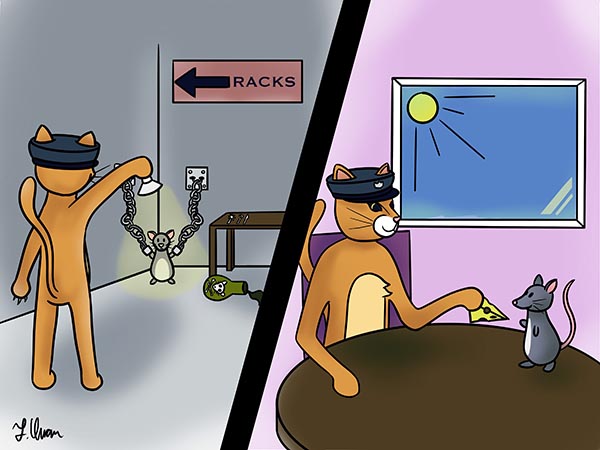
Crime TV shows—Law and Order: SVU, Criminal Minds, The Wire—are not known for their accurate portrayals of the pretrial system. But credit where credit is due. The one thing they almost uniformly get right is the interrogation room. The bleak, constrained, and harshly lit rooms depicted in those shows don’t depart far, in physical design, from the real rooms Americans are questioned in every day.
The design of interrogation rooms is conscious: enhance privacy, limit distraction. In theory, bleak surroundings lead suspects and witnesses to disclose more.
But does that theory hold weight?
Interrogation methods are, generally, untested in scientific settings. “[P]olice officers can tell you how many feet per second a bullet travels. They know about ballistics and cavity expansion with a hollow-point round … [w]hat as a community we have not yet embraced as effectively is the behavioral sciences,” says former special agent and assistant director of the federal government’s primary law enforcement training facility, Mark Fallon.
That’s a problem. Understanding what factors lead people to either lie or mis-recall interactions could significantly help decrease false convictions. According to the Innocence Project at Cardozo School of Law, more than two-thirds of the exonerations made based on DNA evidence involved cases where eyewitness misidentification played a central role. Twenty-nine percent of those total exonerations involved the defendant falsely confessing to a crime.
So, why consider room design?
Put simply:
- Physical environments can increase anxiety
- Anxiety can both inhibit memory recall and increase the likelihood of false confessions
- False or incomplete memories can lead to wrongful convictions.
Physical Environments Matter
In Guantanamo Bay, the CIA admitted to using noise, specifically music, as a form of torture. Fluorescent lighting increases fear in anxiety patients. Temperature, whether too hot or too cold, has been found in studies to increase stress. Colors can elicit a range of emotions in children. Even the shape of the room can have cognitive impacts, with one study finding that curved rooms had greater calming effects than rectangular ones.
The behavior effects of physical environments have been integrated into the court system for centuries. High ceilings and raised benches in courtrooms act as visual expressions of power. It makes sense to consider the cognitive impacts of pretrial spaces as well.
It’s not just suspects that are questioned in interrogation rooms. Witnesses can be too. For suspects, if the design of a space creates more anxiety, that can increase the likelihood of false confessions. For witnesses and suspects alike, anxiety can cause an inability to recall information or a false recollection.
In the case of false recollections, the more these “memories” are “recalled,” the more the individual “recalling” them is confident in their “accuracy.” Jurors correlate confidence with accuracy of memory, even though evidence shows no link between the two. Essentially, we see a snowball effect: what the witness thinks happened becomes what they know happened becomes what the jury knows happened…even though it never actually happened.
So, if the room questioning takes place in induces anxiety in the questionee, there could be a decrease in either (1) the amount of information provided and/or (2) the veracity of that information. Neither is desirable.
Current Research in the Field
Professor Evan Dawson conducted two studies in 2017 on how the “openness” of a mock interrogation room impacts disclosure. In his first study, 112 voluntary participants delivered a flash drive to an actor, pretending to be engaged in a plot to bomb a natural gas site. They were subsequently questioned about that interaction in one of two interrogation rooms.
The first was “custodial setting”—a bare, fluorescent-lit room with two hard chairs and a small table. It mimicked traditional police interrogation rooms. The second was an “open setting”—a larger room with a window and comfortable office chairs at a larger table. The “open setting” was in the same building with the same walls, ceiling, and floor materials as the custodial setting. This space was like what a small conference room in a police station might look like. The open room also included a series of “open primers:” two paintings of nature, a small side table with a water pitcher and cups, and an open book.
Dawson found that participants in the open room disclosed more information and were more forthcoming in their disclosure.
A second study followed, replicating the first but, this time, testing both types of rooms with and without the “open primers” present. Again, participants questioned in the open room disclosed more information than those in the custodial room. Across both rooms, the presence of the “open primers” increased the rates of disclosure by—according to participants—decreasing participant suspicion of their questioner. This second study indicates the room itself, rather than the objects in it, were what caused the increased information disclosure.
A similar study was conducted in 2019 showing no notable differences in disclosure rates based on room size in a mock interrogation setting. However, that study’s design may have rendered its findings less reliable. Dawson’s studies involved greater participant diversity across gender, race, and age, and an experienced counterintelligence agent who was blind to the purpose of the study interviewed the participants. The 2019 study, by contrast, involved exclusively university students (average age of 21.2) who were mostly (82%) female. The research assistants who conducted the interviews were all female and were all aware of the study’s objectives. The gender and age match, plus the inexperience of the interviewers, could have decreased overall anxiety and made the effects of the room change less significant.
Potential Future Studies
It would not be especially costly to replicate Dawson’s study in the real world. Police stations generally have conference rooms. Stations could randomize which suspects are interrogated in their interrogation room versus their conference room to see if, over time, there the location of interviews changes what information is provided. If video evidence is available, interrogators could ask questions to which they already know the answer to compare the accuracy of the information they receive.
Another factor to consider manipulating in a randomized control trial (RCT) could be temperature. Both high and low temperatures can be irritating and impact memory recall. It is common to find criminal defense attorneys warn their clients that these rooms are kept cold. Similarly, lighting could be changed at a low cost. A simple switch from fluorescent lights to LEDs has been shown to increase visual comfort. Seat comfort has been found to increase work productivity, enjoyment, and “flow”—perhaps rolling in a new chair could decrease anxiety in interrogation settings.
Any of these factors could be randomized across interrogation spaces in one or more police stations.
Skeptics could argue that the relative number of individuals currently falsely convicted due to the location that questioning of a witness, victim, or suspect took place is likely low. That may be true. But on questions of life (or, at the very least, liberty), even small improvements are significant for those impacted. Further, even if the impact of the physical environment on the accuracy of information obtained in interrogations is slight there may be other reasons to reconsider how we question criminal suspects and witnesses, such as dignity. Individuals not found guilty for any crime might deserve not be kept for hours in a purposefully uncomfortable setting if there are feasible alternatives that will, if not improve, not decrease truthful information gathering.
Whether to promote accuracy in judicial proceedings, or even just for the sake of human dignity, it is worth questioning how we design interrogation rooms.
If you’re interested in more on this topic, listen to our Proof Over Precedent podcast episode.