Cartoon depicting Mothers Outreach Network (as a bear) giving money to a mother and child (drawn as horses) to buy (horse) shoes.

Testing the Poverty-Child Welfare Connection: Pre-Pilot Study Explores Guaranteed Income

The “Mother Up” pre-pilot program is an evaluation of a guaranteed income project targeting Black mothers in Washington, DC, who are in danger of getting involved with the child welfare system. Studying the efficacy of the program provided the A2J Lab with enough solid data to pursue it on a larger scale and bring an evidence-based voice to the discussion on poverty’s link to child welfare.

Cartoon comparing a household of neglect due to poverty vs. a household with a little more money running smoothly.

At the Poverty Line: Is Money the Root of Family Stability?

Eight hundred families in Illinois–and the researchers working with them–are about to find out. With monthly cash gifts of varying denominations dependent on family size and local cost of living, participants of the EmPwR Study will gain firsthand knowledge of whether a year of guaranteed income will stave off child welfare involvement. HLS J.D. candidate Julia Saltzman examines the relationship between poverty and family regulation system involvement and shares details on the randomized controlled trial taking place in urban, suburban, and rural communities in Illinois.

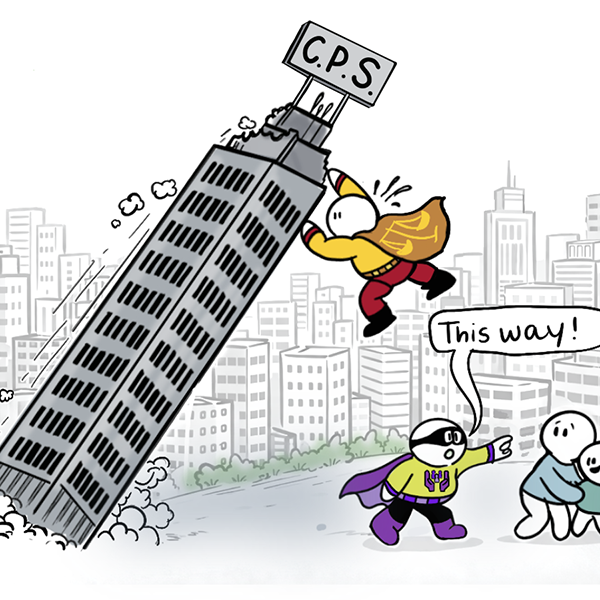
Cartoon depicts Child Protection Services as a falling building, with law and medical support helping to save a family

Inside CHAMPS’ Evidence-Based Holistic Approach to Child Advocacy

This is the story of a traditional law school clinic that has evolved into much more. CHAMPS, the Carolina Health Advocacy Medical–Legal Partnership, is a legal service provider embedded in a healthcare setting. It’s also the field partner for an A2J Lab study evaluating whether legal partnerships can reduce downstream involvement by child welfare agencies in cases potentially due to poverty-related conditions.

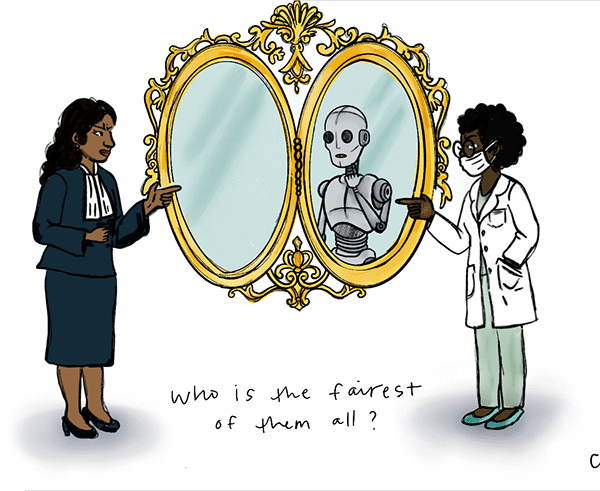
Cartoon depicts individual begging for cash bail to a robot judge who is refusing it

The ‘Robopocalypse’ Fallacy: Lessons from California on Ending Cash Bail

“Replacing cash bail: Fairer justice or robopocalypse?” This headline from a 2020 California news article encapsulates the rhetoric at the time surrounding Proposition 25, a California referendum to eliminate cash bail and provide judges making pretrial release decisions with a risk assessment instrument.

The association of ending cash bail with algorithmic decision-making embodies a complexity that members of the bail reform movement everywhere can examine in future efforts to bring greater access to justice for pretrial detainees.

Cartoon depicts individual not being invited to an expungement party

Can Data-Driven Policy Shape Expungement Uptake?

What if thousands, perhaps millions, of people could stop their past—their criminal record, that is—from following them in job interviews and housing applications? What if some barriers to record clearing could be improved by policy, and not by an individual’s circumstances? Would that improve uptake in expungement? A 2025 article in the North Dakota Law Review addresses the possibilities by examining the current state of record clearing in Pennsylvania and Kansas and potential policy reforms in both states that would produce the greatest number of eligible records for clearing. 

Cartoon depicting an individual seeking information on an arresting officer's badge number for a former offense, with the police captain noting that the officer no longer works there

Record Clearing as a “Rite of Passage”: What Kansas Expungement Reveals About Access to Justice 

Criminal record clearing has become a prominent policy tool for improving individuals’ employment, housing, and reentry outcomes. However, too often, eligibility does not translate into actual access or successful uptake. But why?  A look at the trials and tribulations of the expungement process in Kansas offers insight into the design of criminal law institutions as a whole.

Cartoon depicting an individual throwing out a criminal record while heading into a Michigan job interview

Expungement in Michigan: Between Promise and Outcomes

A landmark study on Michigan’s expungement system found that criminal record clearing was linked to low recidivism rates, no compromise to public safety, and better outcomes for the recipients. But what does it say about the process when those promising results are not enough to entice eligible individuals?

Cartoon depicting a soccer referee adding barbed wire to a prisoner's goal post, showing different regulations applied to prisoners

Ethics and Challenges of Prison Research Regulations

Federal regulations impose additional requirements and restrictions on any Institutional Review Board-approved research that involves incarcerated individuals as subjects. These rules are designed to protect prisoners, a population which has too-often throughout history been taken advantage of by researchers. But how do Subpart C’s extra protections work—and do they even make sense?

Cartoon depicting an individual listening to music but bound to a ball and chain marked by a contract

Do Consumers Fare Better in Court or Mandated Arbitration? 

Conflicting research exists to address whether consumers who “agree” to mandatory arbitration clauses have worse outcomes compared to consumers who are free to litigate in courts. Courts typically assume that by entering a contract mandating arbitration, each party freely bargained for that clause. While there are concerns about how knowingly consumers agree to arbitration clauses, HLS J.D. candidate Rachel Barkin writes about consumer outcomes, based on the dispute resolution process, and potential areas for future research.

Scroll to Top