

By Andrew Reed, J.D. Candidate, Harvard Law School
STUDENT VOICES: The views expressed below are those of the student author and do not necessarily reflect the position of the Access to Justice Lab.
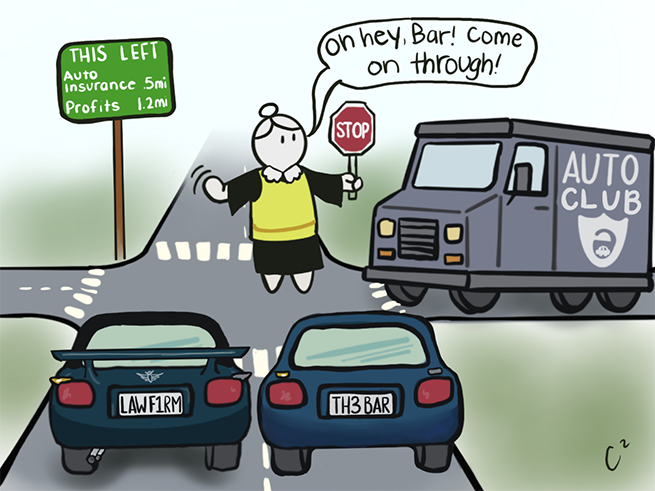
The year is 1920. You’re cruising down Main Street when, suddenly, disaster strikes. A collision with your neighbor’s carriage totals your brand-new Model T. If this happened today, you might pull out your AAA card, hail a tow truck, and get yourself a lawyer (if you can afford it). But back then, your AAA membership wouldn’t just get you roadside assistance—AAA would send you your very own lawyer, ready to represent you in court, at no extra charge.
In the early 20th century, the United States’ automotive clubs—of which there were more than a thousand—weren’t merely in the business of blown tires and dead batteries. These clubs ran serious legal departments, staffed by salaried attorneys who provided an array of free legal services to their members. Whether defending a speeding ticket, contesting an insurance claim, or even battling a serious criminal charge like manslaughter, the auto clubs’ legal teams stood ready to help.
But that was then, and this is now. During the Great Depression, local bar associations turned on automotive clubs and waged a war that resulted in the destruction of the auto clubs’ legal departments.
As Professors Nora Freeman Engstrom and James Stone describe in their Yale Law Journal article Auto Clubs and the Lost Origins of the Access-to-Justice Crisis, the bar filed lawsuit after lawsuit against the auto clubs, accusing them of violating rules concerning the unauthorized practice of law (UPL).
The bar won, and in its victory, destroyed the burgeoning model of group legal services—a cooperative approach in which associations pool resources to provide their members with legal services at affordable costs. The demise of that model was good for lawyers, but bad for everyone else.
This “spirit of protectionism” continues today. As Engstrom and Stone’s article reveals, our current access-to-justice crisis is partly self-made, and its origins can be traced back to the legal profession’s successful campaign against the auto-clubs of the early twentieth century.
The Birth of the American Auto Club
Driving in 1920 was not like it is today. As Engstrom and Stone describe, roads were mostly made of dirt. They were rarely straight and were often disconnected from one another. Cars shared the roads with horses. Sparse regulation meant many drivers had no license and no insurance. These conditions “contributed to a scandalously high accident rate.” The fatality rate per mile driven was “over twenty-five times what it is today.”
Enter the American automotive club. The Chicago Motor Club, one of the founding clubs in the AAA, was formed in 1906. At first, members’ annual dues (approximately $10 per year) only got them mechanical services. But over time, the clubs expanded their services in a variety of ways, such as providing emergency assistance, maps, and even car insurance. The benefits of these clubs were not only felt by members. For example, auto clubs—not the government—were the first to install road signs indicating dead-end streets, railroad crossings, etc.
Access to club legal services, though, was perhaps the primary benefit of membership—so much so that the General Counsel of the Chicago Motor Club once remarked, “If the club had no other service but this legal service, I am of the firm belief that it would be well worth the price of membership.”
Club legal departments operated like law firms. They employed salaried, barred attorneys who represented club members on just about anything related to their car. One club boasted: “No possible legal question can arise from the ownership or the operation of an automobile that the legal department will not handle for club members.”
In practice, these services really were as comprehensive as advertised. Many clubs even offered criminal defense services. Engstrom and Stone described the process as follows:
After a member’s arrest, the member could go to a Club branch office to be directed to a clerk. That clerk would “take record” of the offense, the “time and place of trial,” and the facts surrounding the incident. A lawyer would then be assigned—and the lawyer would “consult” with the member and decide whether “an offense has been committed.” If, after that investigation, the lawyer concluded that the member was “guilty of the offense,” the lawyer would advise the entry of a guilty plea. If, on the other hand, the lawyer concluded that the member was innocent, the lawyer would advise the member to contest the charge—and the Club would furnish representation.
In a single month in 1923, the Chicago Motor Club alone brought more than 250 cases to trial.
The Battle with the Bar
The scope and volume of legal work churning through auto clubs caused the bar to sit up and take notice. At the beginning, though, the bar took no serious measures to stifle group legal services. As Engstrom and Stone describe, in the early 1900s, banks would write wills; unions would file workers’ compensation claims; and neighborhood associations would help homeowners stave off foreclosure.
The bar’s permissive attitude shifted with the Great Depression. Financial conditions put pressure on individual attorneys, who viewed the flourishing group legal services as a threat to their livelihoods. Local bar associations began a coordinated campaign to destroy group legal services. They began with the auto clubs. Local bar associations filed lawsuit after lawsuit, accusing them of violating rules regarding the unauthorized practice of law.
The irony of this argument was, of course, that the attorneys working for the clubs were fully licensed. According to the bar, it didn’t matter. “When a bank or club or organization undertakes to do law work or give legal opinions, even through lawyers constituting its law department, the law work is done in the name of the company and thus deprives individual lawyers of practice they are entitled to and the company has no legal right to.”
In landmark cases like Chicago Bar Association v. Chicago Motor Club, the courts accepted this argument. In that case, in particular, the Illinois Supreme Court adopted the Chicago Bar Association’s recently revised ethics code as the proper authority under Illinois law. In doing so, the Court held that the Chicago Motor Club, and auto clubs like it, were prohibited from providing legal services to their members.
It wasn’t just Illinois. State by state, the bar got its way. By the middle of the twentieth century, not a single auto club offered legal services. In the wake of this change, the biggest winners were—as expected—traditional law firms. The biggest losers were—also as expected—everyone else.
Aftershocks in the Legal Landscape
The collapse of the auto clubs’ legal departments isn’t merely a historical curiosity. As Engstrom and Stone note in their article, this chapter of American legal history changed the regulatory landscape for the legal profession for decades to come.
It may seem odd that the Court in Chicago Motor Club would have taken its cue from the bar, without any input from the legislature, but what followed was even more extraordinary. In the years after the Chicago Motor Club case, most state supreme courts, through the “inherent-powers doctrine,” adopted the view “that courts, and only courts, may regulate the practice of law.” In other words, legislatures were powerless to alter the results of court rulings prohibiting group legal services.
The most stunning example of this came in Massachusetts in 1935, when the state legislature explicitly authorized the provision of legal services by auto clubs. The Massachusetts Supreme Court struck down the law, holding “legislation forbidding the practice of law . . . by corporations or associations . . . is permissible, but that legislation permitting the practice of law by such persons would not be constitutionally competent.”
Insulating the legal profession from legislative regulation has contributed to the current access-to-justice crisis, Engstrom and Stone argue. With courts, rather than lawmakers, in control, reformers aimed at innovating legal services, expanding access, and lowering costs have repeatedly faced judicial roadblocks. The bar’s 1930s victories created a protectionist moat around the legal profession. The demise of auto clubs, therefore, wasn’t simply about legal turf—it created the morass the legal profession finds itself in today—where millions of Americans face complex legal challenges alone, or not at all.
As Engstrom and Stone explain, this was largely by design. “[T]oday’s UPL bans, which continue to stymie the delivery of affordable legal services, have fundamentally rotten roots.” They point to the timing of the bar’s actions. Prior to the Great Depression, while the money was flowing, the bar had little interest in going after group legal services. But once the depression hit, and the bar was in a “difficult economic period,” that’s when the lawsuits came. On the eve of the bar’s crusade, one member of the ABA’s Committee on Unauthorized Practice “explained that the bar needed to act, lest the lawyer be ‘driven from the banquet table at which for centuries he has held a distinguished place.’”
In 1931, Yale Law Professor Frederick C. Hicks noted, “[T]he subject of UPL has been given a new importance by the activities of corporations. So formidable a rival has forced the bar to give heed, because lawyers are being touched in their most vulnerable spot, the pocket.”
Ultimately, the forgotten history of America’s auto clubs reveals a hard truth: The structures that govern our legal system today were not created to protect consumers. They were designed to protect the financial interests of lawyers. When the bar destroyed affordable group legal services, like those offered by auto clubs, it created obstacles to justice that still exist nearly a century later. We take these inefficiencies for granted, but they exist in part because the bar has maintained such tight control. Confronting that reality is essential as we reconsider regulations of the legal profession and move to enact genuine reform. Our job is to serve our clients, not our wallets.
If you’re interested in more on this topic, listen to our Proof Over Precedent podcast episode.