Author name: A2J Lab

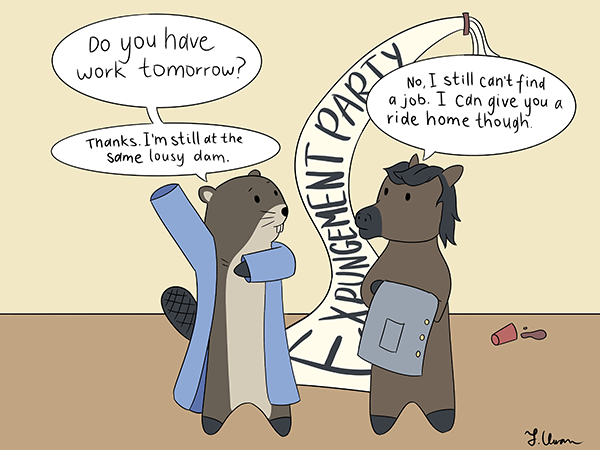
Cartoon depicting two individuals at an expungement party discussing how one can't find a job and the other is dissatisfied at the same job.

The Expungement Experiment: Impact on Employment

Criminal record clearing may help individuals attain jobs, housing, and life satisfaction, according to many criminal justice system reformers. This week, we look at the A2J Lab’s long-running expungement study and the impact of record clearing on employment–a reason 84 percent of our study participants cited for wanting an expungement. The results surprised researchers and clarified policy needs for effective expungement outcomes.

Cartoon depicting an "expungement party" with a blindfolded donkey playing "pin the expungement", showing the challenges associated with obtaining an expungement

The Expungement Experiment: Effectiveness of Legal Aid 

Would-be criminal justice system reformers have long believed that a criminal record inhibits the search for secure employment, housing, and life happiness, and those problems in turn lead to increased recidivism. For reformers, the answer to these challenges has been some kind of criminal justice record clearing. But that theory has only some evidence to support it. In this first of three posts, the A2J Lab dives into its long-running randomized controlled trial in Kansas studying expungement’s impact on reentry outcomes.

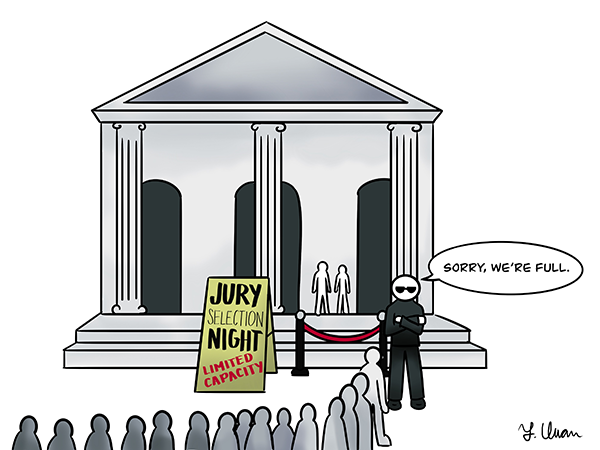
Cartoon depicting a line of potential jurors outside a courthouse with a sign saying the jury selection is at capacity (but only two jurors selected)

Randomizing Reforms to Ensure the Right to an Impartial Jury

The Sixth Amendment right to an impartial jury—particularly for Black defendants facing disproportionately white juries—isn’t always a guarantee. This “Student Voices” blog proposes three reforms to be randomized and studied in real courts, rather than assuming they work, to mitigate possible implicit racial bias in juries.

Cartoon depicting a lawyer helping a tenant navigate an eviction hearing

When Lawyers Matter Most: Lessons from Legal Assistance During Evictions

The premise of right-to-counsel programs is straightforward: if tenants are at risk of losing their homes, and landlords usually have lawyers, then tenants should have lawyers too. But do lawyers actually prevent evictions? And if they do, is it because they win legal arguments in court, or because they help tenants navigate the broader system surrounding eviction? Researchers conducted a randomized controlled trial to learn more.

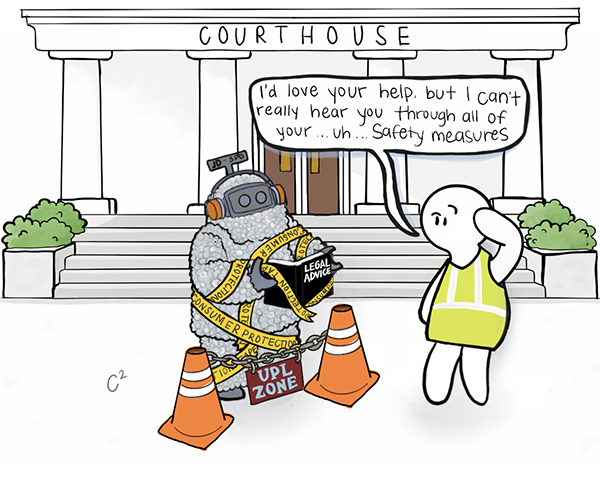
Cartoon depicting a pro se litigant seeking help from AI, but AI is literally tied up in caution tape from UPL regulations

Is UPL Targeting AI to Protect Consumers or Protect Lawyers?

Law could use a tool like AI to bridge the accessibility gap between practitioners and the pro se litigants attempting to navigate the legal field. In this second post in a two-part series on AI and the unauthorized practice of law (UPL), HLS student Elizabeth Guo outlines six points of argument in favor of AI and against UPL as the tool to regulate AI in legal practice.

Cartoon depicting a sign pointing up a long path to Court (10-hour line) vs a sign pointing to a desk with a robot indicating a 5-minute AI decision

Brazil’s AI-Driven Courts: Innovation Without Evaluation

To tackle one of the world’s largest backlog of cases awaiting judicial decisions, Brazil’s courts are relying on AI systems to prioritize cases, support legal research, and even draft judicial decisions. The change in process may help address cases much quicker but at what cost? Largely untested in the justice system, AI’s impact deserves rigorous evaluation before deploying it in real-world situations.

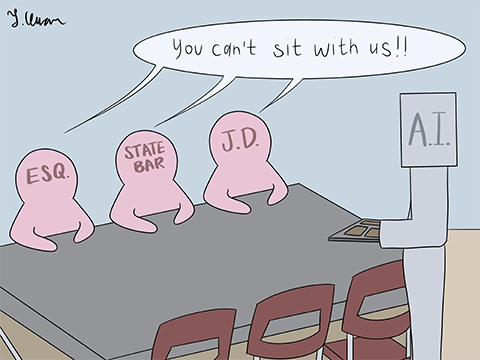
Cartoon depicting AI as a robot not allowed to sit at the lunch table with the lawyers, J.D. candidates, and bar associations.

How Can General-Purpose AI Withstand UPL Scrutiny?

In the first of a two-part series on AI and the Unauthorized Practice of Law (UPL), HLS J.D. candidate Elizabeth Guo explores current UPL rules, the challenging definition of “practice of law”, and the reasons why general-purpose AI tools will not likely be tested by UPL rules when it comes to providing legal information.

Cartoon depicting the bar as autos being allowed through an intersection in which a truck labeled as an auto club must stop.

Collision Course: How the Bar Drove Auto Clubs Out of Court

A Depression-era legal battle between the bar association and auto clubs like AAA pitted the financial interests of lawyers against those of consumers. When the bar won, it not only set forth a future of legal reform controlled by courts rather than lawmakers, it also laid the groundwork for a hundred years of access-to-justice issues that continue to plague the legal profession.

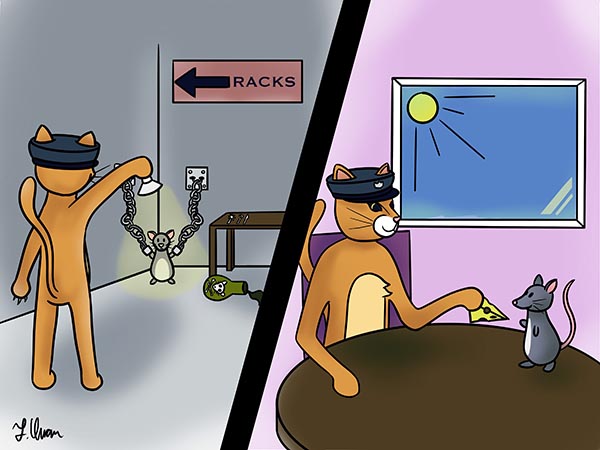
Cartoon depicting a police officer as a cat shining a light on a mouse chained in a room vs. cat in a window-lit room giving a mouse a piece of cheese at a table.

Environments of Justice: Reimagining Interrogation Rooms

In this episode of Proof Over Precedent, HLS student Spencer Thieme discusses interrogation rooms and the effect of a physical environment on stress, memory, disclosure, and false confessions. She also considers potential randomized controlled trials for studying interrogation room design.

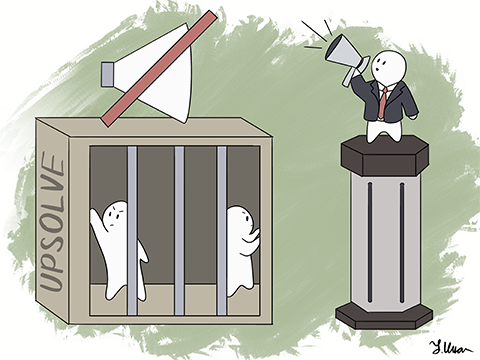
Cartoon depicting Upsolve in jail without a way to communicate while New York courts stand tall with a megaphone in hand

Inside Upsolve’s Legal Fight for Justice Advocacy

Upsolve is a New York nonprofit attempting to create a program in which non-lawyers give limited legal advice to low- income people in debt collection litigation. The organization would be a boon in helping the roughly 80 percent of defendants failing to appear in debt collection court. The only thing standing in its way? New York’s Unauthorized Practice of Law (UPL) statute. HLS student Ashil Jhaveri charts a legal argument based on UPL’s unconstitutionality that could hopefully move the organization forward.

Scroll to Top