

By Kristen Arnold, J.D. candidate, Harvard Law School
STUDENT VOICES: The views expressed below are those of the student author and do not necessarily reflect the position of the Access to Justice Lab.
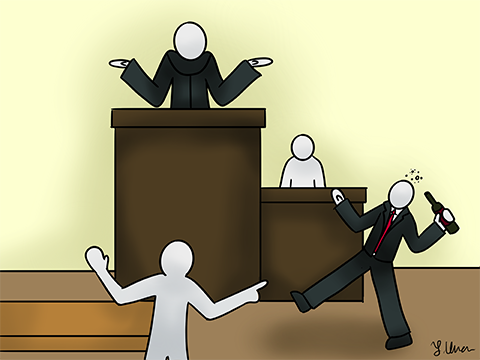
Under the Sixth Amendment, the state must provide people who cannot afford an attorney with “effective assistance of counsel.” In capital cases, this effective assistance could be a matter of life or death. Surprisingly, in practice, courts have found there to be no ineffective counsel when an attorney representing a client facing the death penalty is in the pits of alcoholism, consuming absurd amounts of alcohol and using drugs every day during trial, and is so terrible at their job that the jury heard no evidence of a client’s intellectual disability. So, the client is convicted… and then executed.
Such was the case for Robert Holsey, a man who murdered a sheriff’s deputy after a robbery in Georgia. His lawyer, Andy Prince, a severe alcoholic since age 14, was under investigation for stealing from a client while drinking a quart of vodka each trial day. Prince was subsequently convicted and sentenced to prison. The judicial system refused to find Prince’s representation of Holsey constitutionally deficient. Robert Holsey was executed in 2014.
Holsey’s story suggests the importance of understanding the nature of the theory and practice of ineffective assistance of counsel arguments, particularly in capital cases. This post provides a primer.
The Law Regarding Right to Counsel: Generally, and in Capital Cases
Roughly speaking, the right to state-appointed counsel for defendants who cannot afford to pay for their own lawyer extends to all state or federal criminal cases in which a defendant faces jail time. Further, all defendants who cannot afford an attorney are entitled to one for a direct appeal, if the state allows for such an appeal. This right kicks in as soon as charges are filed, and the defendant is to be informed of this right upon arrest or interrogation.
For cases ending in a death sentence, state and federal defendants often seek multiple avenues for relief. Defendants must ordinarily begin by appealing the conviction, the sentence, or both through the standard appellate process. Unsuccessful defendants may then initiate so-called “collateral” proceedings, sometimes called petitions for writs of “habeas corpus.” These are technically new, civil lawsuits alleging that the defendant’s continued confinement violates constitutional law (either or both of the state or federal Constitution in the case of state defendants) because of some defect in the trial. State defendants may have access to both state and federal collateral proceedings. Federal defendants have only the latter. Depending again on state law (for state convictions), ineffective assistance of trial counsel claims ordinarily must be raised in collateral proceedings (in part because an appellate court lacks the institutional capacity to hear new evidence regarding trial counsel’s performance).
While the Supreme Court has refused to extend the right to court-appointed counsel to state post-conviction proceedings, a federal statute requires that in every federal criminal action which may be punishable by death, a defendant must be provided adequate representation before and after judgment, including post-conviction proceedings. Another federal statute provides state defendants who cannot afford an attorney appointed counsel for federal collateral appeals. This latter statute also sets standards requiring a death penalty attorney to have five years of legal experience and three years of felony experience. A third statute requires that those facing capital crimes in federal court shall have two attorneys appointed – including one attorney learned in capital law, regardless of defendant’s financial status.
With these requirements meant to protect defendants, how do instances of shockingly deficient counsel slip through the cracks? One problem may be in the legal standard necessary applicable to requests to reverse convictions or sentences based on ineffective trial counsel.
“Objective Deficiency” is not Enough Unless it Results in the “Constructive Denial of Counsel”
In Strickland v. Washington, the Supreme Court set out a two-part test to determine whether an ineffective assistance of counsel claim requires reversal of a conviction or sentence:
- First, counsel’s performance must be deficient under the totality of circumstances, based on whether counsel fell below “an objective standard of reasonableness.” This inquiry is stacked against the defendant because the court must make every effort to “eliminate the distorting effects of hindsight, to reconstruct the circumstances of counsel’s challenged conduct, and to evaluate the conduct from counsel’s perspective at the time”.
- Second, the deficiency must have led to prejudice in the outcome (i.e., but for the attorney’s deficiency, the outcome had a “reasonable probability” of being different). This means that a defendant is required to cast doubt upon the trial outcome.
However, in United States v. Cronic, the Court clarified that if performance was sufficiently deficient as to certain key aspects of the proceeding, then the defendant need not prove prejudice separately. The theory is that certain deficiencies in certain trial aspects “are so likely to prejudice the accused” as to render evidence of prejudice unnecessary. Examples include the following:
- The “complete denial of counsel” at a “critical stage” of trial.
- The utter failure to “subject the prosecution’s case to meaningful adversarial testing.” The Court clarifies that the denial of right of effective cross-examination meets this bar.
- The circumstances are such that even a fully competent attorney could not effectively argue a case due to inherent prejudice (e.g., counsel appointed the day a trial began).
Absent a Cronic exception, then, it is not enough that trial counsel be egregiously incompetent. The defendant must also prove either (a) their competence could have reasonably changed the outcome, or (b) effectively, their incompetence was so deficient to be as though they had no attorney at all. But what does this look like in practice?
Applying Strickland and Cronic in Capital Cases: The Good, the Bad, and the Ugly
Examples of the Good
In Wiggins v. Smith (2003) and Rompilla v. Beard (2005), the Supreme Court applied Strickland and held that the failure to introduce readily available mitigating evidence was both deficient and resulted in a prejudicial outcome. In these cases, the Court held that the evidence had a reasonable probability of resulting in a sentence of life in prison instead of death.
In Burdine v. Johnson (2001), the Fifth Circuit sitting en banc held that a defense attorney who slept through the prosecution’s affirmative capital case was equivalent to no counsel at all, utilizing Cronic to presume prejudice.
Examples of the Bad
In Lockhart v. Fretwell (1993), the Supreme Court held that trial counsel’s failure to make an objection that would have almost certainly have changed the result of the trial or sentence under then-extant law did not constitute prejudice if the then-extant law was later overruled to remove the basis of the objection. The court reasoned that the failure to make an objection, sustainable at the time but later unsustainable, did not render the trial result unfair or unreliable. Thus, ineffective assistance of counsel claims need not be tied to the law at the time of trial.
Examples of the Ugly
In Florida v. Nixon (2004), the Supreme Court held that an attorney’s “strategic” decision to tell the jury that their client was guilty during the guilt/innocence trial in a capital case did not constitute ineffective assistance of counsel because the defendant had not proven prejudice. The fact that the defendant might not or did not consent to the use of such a tactic was irrelevant if, for example, there was in the Court’s view no prejudice because the prosecution had “overwhelming evidence.”
In McFarland v. Lumpkin (2022), the Fifth Circuit denied federal habeas relief to George McFarland, a man who has been on death row for over 30 years, despite the fact that one of his attorneys, John Benn, prepared for a total of four hours and slept through large portions of the trial. Jurors after the trial described this attorney’s hibernation as “blatant and disgusting.” The court commented, “[W]e are aware of no case where a sleeping co-counsel alone triggers Cronic’s presumption of prejudice.” Further, in looking to McFarland’s other attorney, Sanford Melamed, the court found that the decision to not interview witnesses was “strategic” given limited resources and therefore deferred to the lower court’s finding of competency.
Holsey v. Warden (2012) is summarized above. Relevant in this case was the lower court’s finding of lack of prejudice under the Antiterrorism and Effective Death Penalty Act of 1996 (AEDPA). AEDPA requires a federal habeas court to deny relief unless a defendant proves that the state court unreasonably applied clearly established federal law or was based on an unreasonable determination of the facts based on evidence presented in a state court proceeding.
The upshot is an attorney can be drunk, asleep, or concede guilt, and a defendant’s rights are not violated, unless they are able to prove that the outcome would have been different.
Looking Ahead: What can be Done?
It is unlikely that the Supreme Court will expand Cronic or alter the demanding standard of Strickland that requires reasonable probability of prejudice in outcome. There are other avenues of reform. The ABA could toughen its standards regarding sanctioning attorneys whose behavior is found deficient under Strickland. Currently, the ABA allows sanctions when conduct falls under Strickland’s prejudicial standard, per Rule 8.4 (d). True, it is possible that such a step could backfire because if lawyers know they face sanctions for deficient performance, they may be less likely to cooperate in Strickland claims. Similarly, courts may be more reluctant to find Strickland prong one met if such a finding triggers sanctions. However, some jurisdictions compel cooperation of trial counsel and when they do not, counsel typically defend themselves against claims. Moreover, a finding of prong one of Strickland is irrelevant if prong two (prejudice) is not also found, so a court’s reluctance to find prong one would be harmless to the defendant’s outcome.
Congress could repeal AEDPA. The state’s interest in the finality of a death sentence is not enough when trial counsel’s performance is both deficient and prejudicial but not the “unreasonable” on its face or when a state court’s ruling is not an “unreasonable application of clearly established federal law.” The matter is, after all, one of life or death.