

By Rachel Barkin, J.D. Candidate, Harvard Law School
STUDENT VOICES: The views expressed below are those of the student author and do not necessarily reflect the position of the Access to Justice Lab.
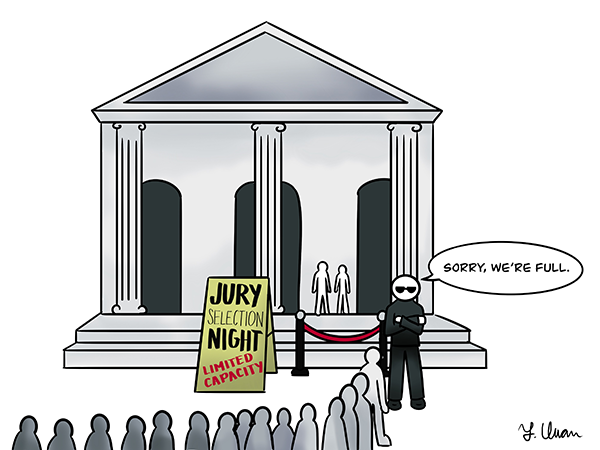
The Sixth Amendment states that defendants in criminal trials have a right to an “impartial jury.” An impartial jury renders a verdict based on the facts at trial, not their biases toward the prosecution or the defendant. Juries must be demographically representative of a defendant’s community, in part to mitigate these biases and reflect accurately community norms.
Historically, many states intentionally denied Black defendants their right to a jury trial, let alone an impartial jury, and excluded Black people from serving on juries. Today, all-white juries, or disproportionally white juries, persist in criminal trials. The reasons for disproportionately white juries are disputed, but they persist despite a Supreme Court holding that attorneys cannot make peremptory strikes based on race.
By way of background on the last point: A peremptory strike is when, after a process of questioning potential jurors called voir dire, attorneys for each side may remove a certain number of jurors (determined by state law and the offense) from the jury pool for any reason except race or gender. Enforcing the prohibition on preemptory strikes based on race or gender is difficult because it is hard to separate legitimate from prohibited purposes.
Even when juries do represent a defendant’s community, there is the possibility that some members may have implicit racial biases. Eberhardt et al. (2004) discuss extensive research finding that people of all races can hold implicit biases towards Black Americans. But the empirical research on whether implicit racial biases seep into jury decision-making is inconsistent. Conducting a meta-analysis, Mitchell et al. (2005) found that there is a small but significant effect of racial bias in jury decision-making. However, Pfeifer (1990), also conducting a meta-analysis, found the opposite, i.e., that there was little evidence of inherent racial bias within juries.
This blog post discusses three reforms to mitigate possible implicit racial bias in juries: 1) require implicit bias jury instructions, 2) ban peremptory strikes, and 3) increase the number of jurors.
- Require Implicit Bias Jury Instructions
Using mock trials and juries, Lynch, Kidd, and Shaw (2022) studied whether implicit bias instructions affect jury verdicts. They found that implicit bias instructions and the race of the defendant did not significantly affect jury verdicts. However, jurors who received implicit bias instructions were more likely to discuss their duty to avoid their implicit biases during jury deliberations.
These researchers conducted in-person simulations of federal narcotics conspiracy trials. Using a 2 x 2 x 2 factorial design, they created eight experimental conditions. Across the experimental conditions, they varied the race of the defendant (Black or white), the race of an informant witness (Black or white), and the jury instruction (implicit bias or standard bias). The study consisted of 623 jury-eligible participants within the local community in which a courthouse was located. The researchers assigned each participant to a jury group of four to seven people based on their availability, and then randomized the experimental conditions across jury groups. The judges read one of these two jury instructions after the trial:
Standard Bias Instruction: “You must decide the case solely on the evidence and the law and must not be influenced by any personal likes or dislikes, opinions, prejudices, or sympathy.”
Implicit Bias Instruction: “You must decide the case solely on the evidence and the law before you and must not be influenced by any personal likes or dislikes, opinions, prejudices, sympathy, or biases, including unconscious bias. Unconscious biases are stereotypes, attitudes, or preferences that people may consciously reject but may be expressed without conscious awareness, control, or intention. Like conscious bias, unconscious bias, too, can affect how we evaluate information and make decisions. It is important that you discharge your duties without discrimination, meaning that bias regarding the race, color, religious beliefs, national origin, sexual orientation, gender identity, or gender of the defendant, witnesses, and the lawyers should play no part in the exercise of your judgment.”
The researchers also gave the jurors access to these instructions during their deliberations. After reaching a verdict, each juror answered survey questions about their perceptions of the witness’ testimony, the attorneys, the defendants, the judge, and their comprehension and perception of the jury instructions. The survey included racial bias measures drawn from Williams & Eberhardt’s (2008) Race Conceptions Scale and Pettigrew & Meerten’s (1995) Subtle Racism Scale. The researchers also ran binary logistic regressions to assess whether the instruction conditions and the race conditions affected verdicts. Additionally, they coded transcripts of the jury deliberations using 27 thematic categories to assess how the instructions influenced the deliberations.
The results were mixed. The researchers found that the jury groups that received the implicit bias instruction were more likely to discuss their duty to avoid bias, acknowledge their own bias, or accuse others of having bias. That said, there was no evidence that the implicit bias instruction significantly affected verdicts. Although it is promising that these instructions prompted conversations about implicit bias during the deliberations, those conversations sometimes detracted from equally important discussions about witness credibility. A strength of the study is that it randomized the two different jury instructions across a large sample size of participants. Researchers could improve this kind of study through randomizing implicit bias jury instructions among actual juries.
- Ban Peremptory Strikes
DeCamp and DeCamp (2020) found that during voir dire, prosecutors were 4.51 times more likely to strike Black people compared to white people. Defense attorneys were 4.21 times more likely to strike white people than Black people.
As a result, the juries were less diverse. There are several potential reasons why the defense attorneys’ and prosecutions’ opposing tendencies did not cancel each other out. First, juror pools might already have been unbalanced before strikes began. Second, it can matter that the prosecution strikes first. Third, it can matter that racial minorities make up a smaller percentage of the population. To understand the last point, suppose that the pre-strike jury pool consists of nine white members and three Black members, and each side gets three strikes. If the prosecution is 100% likely to strike Black people and the defense is 100% likely to strike white people, the result will be an all-white jury.
These researchers ran a regression using records of 2,542 potential jury members in
voir dire (“venire members”) in 89 criminal trials in Mississippi’s Fifth Circuit Court District between 1992 and 2012. They removed venire members from the data set if attorneys struck them for reasons other than peremptory challenges but did not control for the type of trial. After running the regression, they utilized a statistical technique called “propensity score matching” to isolate the effects of the predictor variable, the venire member’s race. This technique mitigates the problem in regressions where researchers cannot control for overlapping effects of correlated predictor variables, e.g. race and class. Researchers often use this design when they cannot use an experimental design such as an RCT. This technique cannot, however, correct for variables not included in the modeling, and for that reason it is not as strong as an RCT.
It appears that no researcher has conducted an RCT studying a potential reform of removing peremptory challenges entirely. Such research would build upon studies like DeCamp and Decamp (2020) by more accurately evaluating the impact of peremptory challenges on affecting the racial composition of a jury. And then in turn, researchers can also study whether affecting the racial composition of a jury leads to different outcomes for non-white defendants. Researchers could work with Arizona, which has banned peremptory challenges (or a state that is considering a ban) and convince them to exempt the ban for some trials and not others to randomize the availability of such challenges. This method is called “randomizing law.” Note that there is no constitutional right to peremptory challenges and remember, for-cause strikes are always available.
- Increase Jury Numbers
Traditionally, common law required at least 12 jury members in a criminal trial, until the Supreme Court lowered the requirement to at least 6 jury members. But there is no maximum on how many people can serve on a jury (e.g. Massachusetts uses as many as 14 jurors in some settings). States can leverage their freedom in this area by studying whether increasing jury numbers mitigates the issue of all-white juries and improves outcomes for non-white defendants. Just as increasing the sample size in an experiment improves accuracy, increasing the jury size may ensure it is a more accurate representation of the defendant’s community.
Watanabe (2020) found that the best jury size is 12 members based on the accuracy and efficiency of verdicts. He ran a regression using data on actual jury verdicts and compared those to hypothetical community verdicts (i.e. the same decision made by other community members). He defined accuracy as whether the actual jury verdicts matched the community verdicts. While this study is a starting point, he does not provide enough information on his data sources for the actual verdicts and the community verdicts.
Here are some recommendations for researchers who would like to build on the concept of Watanabe’s study. Researchers can work with certain specialized state courts to randomize which trials have larger juries. For example, a researcher could request the Massachusetts legislature to enact a law requiring 20 jurors in juvenile court trials, while exempting certain trials from that law. The exempted trials would have the current default of 6-7 jurors in juvenile courts. By randomizing this law, researchers can evaluate whether increasing jury size impacts outcomes for non-white defendants.