

By Elizabeth Guo, J.D. Candidate, Harvard Law School
STUDENT VOICES: The views expressed below are those of the student author and do not necessarily reflect the position of the Access to Justice Lab.
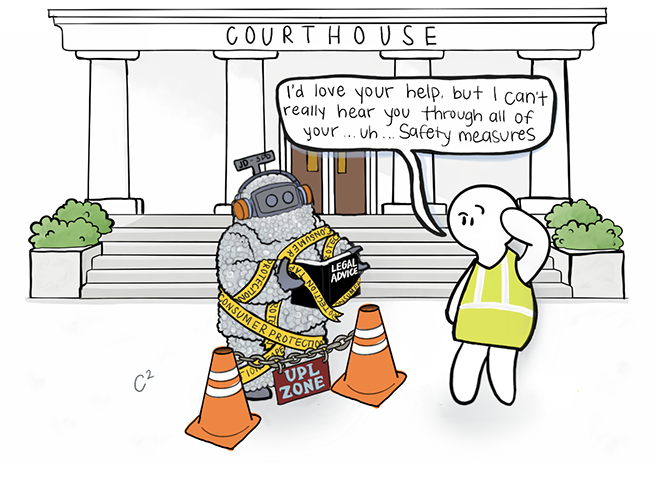
Litigation has begun over whether AI platforms can be liable for the unauthorized practice of law (UPL). On March 4, 2026, life insurance company Nippon filed suit against OpenAI in the Northern District of Illinois, alleging “a) tortious interference with a contract; b) the unlicensed practice of law; and c) abuse of process.”
The actual ChatGPT consumer, Graciela Dela Torre—who is not a party to the case—was a disability claimant who had settled a disability benefits suit against Nippon with prejudice in 2024. According to the complaint, Dela Torre was dissatisfied with her attorney’s response to her concerns about the settlement terms and uploaded that response to ChatGPT. ChatGPT allegedly confirmed her concerns. She then fired her attorney and used ChatGPT to help draft motions and other filings to reopen her lawsuit. The court denied Dela Torre’s motion to reopen. Then, Dela Torre initiated another lawsuit against two other companies, using ChatGPT to draft that complaint and add Nippon as a party. Nippon now seeks, among other things, declaratory relief that OpenAI violated Illinois’ UPL statute; a permanent injunction barring OpenAI from “engaging in the practice of law” in Illinois; and $300,000 in compensatory damages, $10 million in punitive damages, and reasonable costs and attorney’s fees.
The first post in this two-part series provided background on UPL rules in the U.S. and explained why state UPL laws likely allow general-purpose AI to serve as a resource available to pro se litigants. This post will explain why, as a normative matter, UPL rules should not outlaw general-purpose AI used by pro se litigants. To be clear, users and regulators should discipline the use of AI for legal practice—but UPL enforcement is not the right tool for doing so. This post offers six main arguments:
- The case for AI and access to justice is strong.
- The case for UPL and consumer protection is weak.
- Other regulatory and disciplinary tools are better suited to address concerns about AI and consumer protection.
- It would be unfair to ban AI for pro se litigants while allowing judges and lawyers to use it.
- It would be strange to ban AI for law but not for other consequential uses.
- At this point, the toothpaste is already out of the tube.
1. The case for AI and access to justice is strong
General-purpose large language models (LLMs) may be well-positioned to assist indigent pro se litigants for several reasons. First, LLMs can assist with a variety of commonplace tasks. According to a New York State Bar Association article, such tasks can include “drafting legal letters to courts preparing defenses (e.g., parking tickets)”; “addressing procedural requirements, such as opening statements”; and “read[ing] and summariz[ing] hundreds of pages of documents.”
Second, LLMs are available to users for free or low cost. Tools such as ChatGPT and Claude offer free options as well as more advanced plans for $20 per month. The tools are easy to use. They feature an intuitive chat interface that accepts plain-English prompts and is accessible through a single web portal.
Third, there are signs that AI has already helped pro se litigants. One litigant used ChatGPT and Perplexity to overturn an eviction notice and avert $55,000 in penalties and $18,000 in overdue rent. Several law firms have reported increases in pro se filings using AI. While some have expressed concern about AI enabling an increase in frivolous claims, others have noted that AI has “‘taken away the intimidation factor’ from pro se litigants” and “is making their arguments stronger.”
2. The case for UPL and consumer protection is weak
The rationale that state UPL commentaries often invoke—consumer protection from incompetent or fraudulent representation from non-attorneys—lacks force when applied to AI. As to the incompetence concern, AI models are improving rapidly. In 2023, GPT-4 passed a simulated bar exam and scored around the 90th percentile. GPT-3.5, by contrast, had scored in around the 10th percentile. As of March 2026, Google’s Gemini 3 Pro and Flash as well as GPT-5 and 5.1 had scored above 85% on a benchmark called LegalBench that measures abilities including issue spotting, rule recall, rule application, legal outcome prediction, and interpretation. As to the fraud concern, disclaimers that AI cannot provide legal advice and should not substitute for an attorney—which leading LLMs already use, to an extent—should help reduce consumer confusion.
Meanwhile, it has never been clear that UPL enforcement in practice centers around the protection of consumers. A survey by Deborah Rhode and Lucy Ricca published in 2014 found that over two-thirds of respondents (chairs or counsel of state entities responsible for UPL enforcement) “could not recall an instance of serious public harm in the preceding year.” Seventy-eight percent thought that UPL was a threat to attorneys. And forty-two percent “reported that over half their complaints came from lawyers,” not consumers. The unfolding Nippon v. OpenAI litigation is another example of a UPL complaint that did not originate from the consumer.
When it comes to pro se litigants, the choice is likely not between “lawyer or AI,” but rather “no help or AI.”
3. Other regulatory and disciplinary tools are better suited to address concerns about AI and consumer protection
The provision of bad information and hallucinated citations from AI is a real concern. Courts have already caught hallucinated citations in pro se litigant-submitted filings. Pro se litigants, who are more likely to lack the resources and wherewithal to question an LLM’s outputs, are particularly susceptible to such mistakes. But UPL is a blunt tool that does not distinguish between high- and low-quality technology, or technology that harmed and did not harm consumers. A total ban on the use of AI in law is an overreaction.
Other regulatory and disciplinary tools would be better tailored than UPL to address the provision of bad information. First, harmed consumers can still bring private lawsuits against AI platforms. Some scholars have argued that products liability would be a more sensible doctrinal path for relief. Second, FTC enforcement can address concerns about AI deceptive claims and unfair practices. For example, under Operation AI Comply, the FTC took action against self-named “robot lawyer” DoNotPay for false claims. Third, AI safety regulation, such as California’s SB 53, could encourage greater AI safety upstream of user involvement. Fourth, regulation could require clearer disclaimers in model outputs (see my questionable exchange with ChatGPT about legal advice here), in addition to the disclaimers tucked away in platforms’ usage policies. Fifth, regulation could require minimum errors and omissions liability insurance, similar to that for autonomous vehicle testing companies. Finally, some federal judges have ordered pro se litigants to disclose the use of AI and certify citation accuracy. Expanding such practices across courts could nudge pro se litigants to think twice and verify AI outputs prior to filing.
4. It would be unfair to ban AI for pro se litigants while allowing judges and lawyers to use it
Enforcing UPL against AI providers would create an additional asymmetry between actors in the legal system. As a practical matter, UPL enforcement would deprive pro se litigants of a helpful resource. By contrast, licensed attorneys would be able to use AI—as they do already—because unauthorized practice disputes, by definition, do not arise with an attorney in the loop. Judges, too, are increasingly using AI both for assistance when their resources are stretched thin (such as in reviewing default judgments) and for day-to-day tasks such as summarizing documents and generating questions. One federal magistrate judge in California stated that she keeps Claude “open all day.” Why should pro se litigants—already the most disadvantaged participants in the courthouse—be denied a resource available to others?
5. It would be strange to ban AI for law but not for other consequential uses
If courts were to hold AI providers liable for UPL, should they not also ban AI as used in other consequential non-legal situations? For instance, a user in desperate need of a job to support herself might turn to ChatGPT for assistance with her job search, and the same risk of mistake would exist. Yet, because “job searching” does not constitute the practice of any licensed profession, it likely cannot be banned in the way that UPL would ban AI from legal practice. Another example is tax filing; using an LLM could lead to significant miscalculations, yet UPL would leave that untouched. UPL liability might prove too much. That liability regime would not distinguish law from other (arguably more) consequential areas of life.
6. At this point, the toothpaste is already out of the tube
AI may have gotten “too big, too fast” for UPL to serve as a regulatory restraint. Uber’s rise in the last decade is illuminating. There were valid legal arguments that Uber drivers had been misclassified as independent contractors rather than employees. But Uber’s rapid expansion outpaced existing regulatory frameworks and made oversight nearly impossible. So too here: Given the versatility and ubiquity of today’s LLMs, it might simply be impractical for bar associations—or life insurance companies, for that matter—to try now to hold AI providers liable for one particular use of AI (alleged practice of law) by one particular kind of AI user (pro se litigant).
If you’re interested in more on this topic, listen to our Proof Over Precedent podcast episode.