

By Sydney Nelson, J.D. Candidate, Harvard Law School
STUDENT VOICES: The views expressed below are those of the student author and do not necessarily reflect the position of the Access to Justice Lab.
Independence and Accountability
By design the judiciary was structured to foster independence, recognizing that to promote the rule of law, judges may need to make decisions that are unpopular and to avoid yielding to the majority at the expense of the minority. The Constitution fosters this independence by providing for federal judges to be appointed for life and insulated from threats to their salary or tenure. Judicial independence is often understood as including two types – institutional independence, meaning the judiciary is protected from undue influence from the other branches of government, and individual independence, meaning judges make decisions free from undue influence from outside parties.
Judicial independence and accountability are “two sides of the same coin: accountability ensures that judges perform their constitutional role, and judicial independence protects judges from pressures that would pull them out of that role.” Judicial accountability is the idea that “judges must be accountable to the public for their constitutional role of applying the law fairly and impartially.” Judicial accountability can also be broken down into three types – institutional, behavioral, and decisional. Institutional accountability concerns the judicial branch as a collection of judges. Behavioral accountability addresses the conduct of judges on and off the bench. Decisional accountability focuses on the rulings that a judge makes. Judicial accountability promotes judicial independence, both serving to uphold the rule of law. Under the rule of law, justice is accessible, just, and impartial.
When it comes to accountability, the legislative and executive branches find their legitimacy in, and are held accountable through, elections. How is the public to hold the judiciary accountable, if at all? Interestingly, despite their inability to directly choose their federal judges, the public has largely regarded the judiciary more favorably than the other two branches of government. However, in the last 25 years, Americans’ confidence in the federal judiciary has dropped nearly 30 percentage points, down to 49% in 2025,as compared to a 34% drop in confidence with the legislature and 22% with the executive. As trust decreases, the question of how judicial accountability is achieved becomes increasingly pressing.
Transparency as the Missing Ingredient
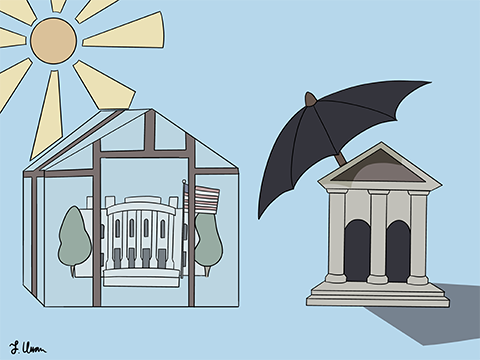
U.S. Supreme Court Justice Louis Brandeis is known for his time on the bench and for his quote, “Sunlight is said to be the best of disinfectants,” referring to the benefits of transparency in politics and government in reducing corruption. The court system operates under a presumption of public access. In Richmond Newspapers Inc. v. Virginia, the Supreme Court held that “the right to attend criminal trials is implicit in the guarantees of the First Amendment.” While the Court has extended this reasoning to written proceedings available in courthouses, some scholars have argued that the extension has not kept pace with the times. For example, the public is charged a fee to access digital court records, such as those stored in PACER.
Where the Court has failed to extend the legal reasoning to digital documents in cases, Congress has also largely been hesitant to enforce transparency standards on the judiciary. That hesitancy contrasts with Congress’s willingness to impose transparency measures on the executive. Three major transparency acts of Congress pertain to the access and publication of records and information. All three acts apply to the executive branch, while only one applies to the judiciary.
| Title | Focus | Judiciary | Legislature | Executive |
| Freedom of Information Act, amended 2016 (1966) | Provides the public with the “right to request records from any federal agency” | X | X | ✓ |
| E-Government Act of 2002 | Established “a broad framework for the use of technology to enhance access to government information” | ✓ | X | ✓ |
| OPEN Government Data Act (2019) | Requires “federal agencies to publish their information online as open data, using standardized, machine-readable data formats” | X | X | ✓ |
While the traditional argument has been that Congress has the power to provide financial and operational oversight over the federal judiciary, in reality, the judiciary is resistant to efforts that appear to encroach on the branch’s sphere of influence, asserting that oversight interferes with judicial independence. The judiciary is protective of its purported ability to self-regulate and self-monitor, and the judiciary’s strategic plan emphasizes the importance of self-enforcement.
The one act among these three major transparency laws applicable to the court is the E-Government Act of 2002, which requires each court “to establish and maintain a website that provides the public with access” to specific information. Requirements include docket information for each case, all documents filed with the courthouse, and all written opinions. However, these categories themselves have discretion. For example, authoring judges make the decision themselves of whether a writing constitutes an opinion.
Additionally, documents under seal are not required to be available to the public. Scholars have argued that sealing is overused, with motions to seal among the most common filings and growing evidence that judges are not holistically evaluating motions to seal before granting them. Judges may not be the most reliable when it comes to closely monitoring what is and is not published. Carl Malamud, founder of Public.Resource.Org, conducted an audit of 32 district courts, and identified at least “1,669 documents with verified Social Security numbers and other issues,” in violation of the federal rules of civil procedure.
Measuring Access to Justice
Increased transparency would help the public evaluate how close the judiciary is to meeting its constitutional role and its own strategic goals. One of the core values of the federal judiciary is equal justice, which is described as “fairness and impartiality in the administration of justice; accessibility of court processes; treatment of all with dignity and respect.” These principles align with fundamental value of access to justice. The access to justice gap is real; however without transparency, it is challenging to measure the extent to which the gap pervades our federal judicial system. The data and information needed for researchers, academics, and the public to understand the current state is artificially out of reach.
Something needs to change. The current posture is not sustainable as public trust declines, the rule of law is increasingly under attack, and access to justice remains elusive. The American public would do well to push the federal government to adopt measures that further promote judicial transparency, thereby enabling an independent, accessible, and accountable judiciary.
If you’re interested in more on this topic, listen to our podcast episode.