

By Sydney Nelson, J.D. Candidate, Harvard Law School
STUDENT VOICES: The views expressed below are those of the student author and do not necessarily reflect the position of the Access to Justice Lab.
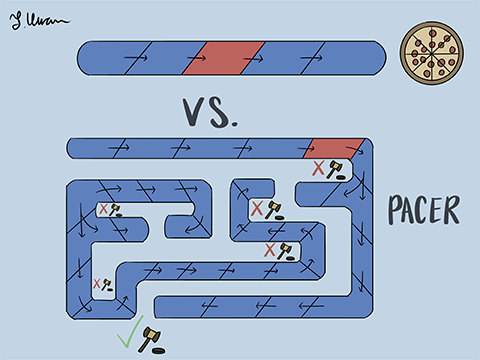
In the world of user experience and design, the Domino’s pizza tracker is famous. Back in 2009, when Domino’s was experiencing declining sales and criticism about the quality of its pizza, it decided to do something radical for a business—the company embraced transparency by launching a pizza tracker. While novel at the time, one now sees echoes of the Domino’s pizza tracker anytime there’s a digital tool that has broken a process into visual stages and displays live to the customer where they are in that process. The effect has grown. Consumers have come to expect quality user experiences when leveraging digital tools, such as websites or applications.
Federal court case record systems are long overdue for their own pizza tracker. This blog post is part of a series exploring how to increase access to case information to improve access to justice more broadly. The first blog post examined the concept of open court data. This post discusses the user-friendliness of court record systems for individuals who are not attorneys or repeat players.
The Creation and Attempted Modernization of PACER
In 1988, following the rise of personal computer sales, the federal judiciary launched PACER (Public Access to Court Electronic Records) as a court record system. Then, in 2001, federal courts adopted CM/ECF (Case Management/Electronic Case Filing), allowing parties to electronically file before the court. Between the two systems, CM/ECF enabled lawyers to file documents, while PACER allowed the public, including lawyers, to access those records. By some measures, the two systems were successful—while 11 U.S. District Courts used the systems in 2002, within five years the usage was nearly universal. Together, the systems are regarded as “the oldest, largest, continuous, integrated case management and e-filing system in the world.”
Despite their impressive beginnings, PACER and CM/ECF have been slow to keep pace with technological change. In 2009, the federal judiciary began exploring requirements for modernization. The updates required eight years to implement, beginning in 2014 and ending in 2022, when all federal courts had transitioned to NextGen CM/ECF. The major public-facing update was establishing a Central Sign-On (CSO), meaning that filers could use one “PACER account to access PACER and any NextGen court in which (they were) allowed to file,” rather than having to maintain separate CM/ECF accounts for each court. Most of the updates focused on improving capabilities for chambers and judicial use rather than on the needs of public users.
Criticisms of NextGen CM/ECF include that it was merely a facelift on a few parts of the system, and that it did not fundamentally improve the user experience. Competing platforms, such as PacerPro, RECAP, and PacerMonitor, promised a better user interface and experience for searching and viewing federal court cases. Members of Congress expressed frustration at the pace and scale of updates and attempted to pass versions of the “Open Courts Act” in both 2020 and 2021. One of the co-sponsors, Senator Dick Durbin (D-IL), emphasized that, “The PACER system is not keeping pace with reality or technology.”
In 2022, the planning began for the next wave of modernization—the Case Modernization Effort (CMM) which is intended to replace NextGen CM/ECF and will serve as a “modern, sustainable platform for the Judiciary to manage cases and improve communication, collaboration, and engagement among courts, the public, and other partners.” The judiciary announced an acceleration of this modernization effort in March of 2026 in response to a cyber-attack on the case management system. The judiciary shared that it expected most of the updates to be completed within the next two to three years.
Failing to Design for Pro Se Litigants
This modernization effort risks falling into the same pitfalls as NextGen by inadequately accounting for individuals who are neither attorneys nor repeat players, namely pro se litigants. While most users of PACER are attorneys, pro se litigants are not insignificant. At the federal level, “in 2021, more than 100,000 cases involved pro se parties, comprising more than 25% of the non-prisoner civil docket in federal courts.” Despite the challenges pro se litigants face, rhetoric by the federal judiciary seems to imply that these litigants struggle to receive attention in system modernization efforts.
For example, in 2021, the Administrative Office (AO) of the United States Courts conducted a user satisfaction survey. The survey was sent to individuals who had used PACER at least once in the previous year; out of the total sample of 59,133, 11%, or 6,315, responded. 10% of those who responded identified themselves as plaintiffs, defendants, or debtors—in contrast 63% of respondents represented the legal sector, with the majority working for a law firm. Despite the substantial differences in these two user groups—their education level, occupation, familiarity with the judicial system, frequency of PACER use—the survey appears to pose the same questions to both and combines their responses in the results. Thus, any improvements or areas of focus as highlighted by the survey, such as the fact that PACER usage on mobile devices is not common, will likely reflect the legal sector’s job-related usage rather than a pro se litigant tracking their own case.
Another example is the Electronic Public Access (EPA) User Group, an advisory group established by the Administrative Office of the U.S. Courts, does not appear to include any pro se litigants. The EPA User Group helped craft the questions for the user satisfaction survey, which would help explain why the survey did not appear to reflect the questions a pro se litigant might have.
This exclusion is unfortunate—as of 2025, 96% of adults in the United States use the internet, up from 74% when PACER and CM-ECF were first fully implemented in 2007. In adjacent spaces, such as customer service, consumers prefer to get a status update digitally, rather than requiring interaction with a human. In contrast, anecdotally, court staff has shared that they often receive phone calls from litigants inquiring about the status of their case—likely because PACER is so challenging to navigate. And those involved with the court system respond to electronic means of communication: text messages sent to remind litigants of upcoming court dates reduced bench warrants and lower incarceration for missed court dates by 20%. Despite the growing capacity for PACER to serve as a tool for pro se litigants, pro se litigants appear to receive insufficient consideration.
Embracing Targeted Universalism in Design
From a business perspective, it may make sense to focus on the court system’s highest volume users, who also likely generate the most in fees, especially given that about 85% of the modernization project’s funding comes from PACER fees. But the court system is not a business, it’s a public channel for justice. There is a difference between designing for the masses and designing for those who have been historically marginalized—or the users furthest from justice. Given that pro se litigants experience so many barriers, the Court should consider embracing targeted universalism. Targeted universalism “pursues universal goals with targeted or tailored measures, programs or interventions.” In this way, the courts could consider how the needs of a lawyer differ from that of a pro se litigant, and how each user group might require different things of PACER.
If the court system truly wants to achieve its strategic goal of improving access for pro se litigants, including ensuring “comprehensive, readily accessible information about court cases,” the court system should consider how to design PACER with pro se litigants in mind. The Domino’s pizza tracker is one idea to help represent visually where a case is in the process. The federal judiciary can promote the use of plain language, simpler and more intuitive navigational paths, and other features to help pro se litigants new to PACER leverage it as they pursue their case. As the CMM effort accelerates its timeline, it should not forget to take a page out of Domino’s book and ask—besides pizza, what do pro se litigants want?
If you’re interested in more on this topic, listen to our podcast episode.