Miscellaneous

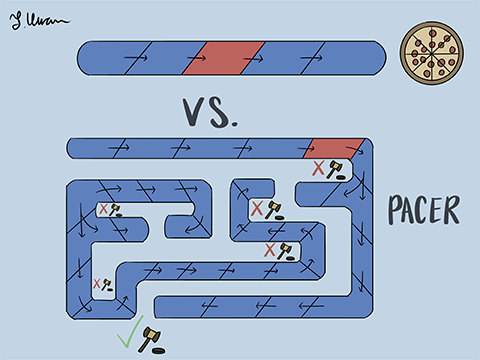
Cartoon depicting a pizza tracker's linear progress versus PACER's less user-friendly court record system

A Court Case Tracker for the People

What happens when a system ignores the needs of one-quarter of its users? This week’s “Student Voices” post argues that PACER’s online court records meet the usability needs of lawyers and court staff, about 75% of its users, but fail to account for the remaining users, mainly pro se litigants, who interact with the system. While the federal judiciary works to modernize PACER in the next few years, user-centered design could help improve accessibility for those representing themselves.
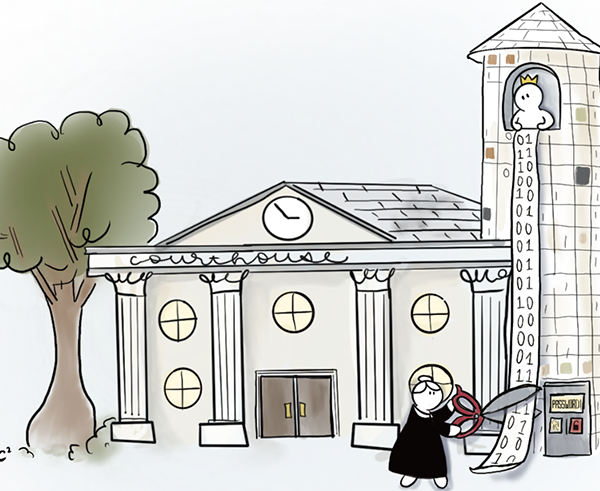
Cartoon depicting a princess in a tower holding a strip of paper revealing data ( in 1s and 0s) with a judge at the bottom of the tower cutting off access to the data with scissors

A Princess in the Tower: The Case for Setting Court Data Free

The U.S. judiciary suffers from a trust issue among the general public, largely due to its fragmented, unusable, costly, and difficult-to-access data. That is the argument put worth in this week’s “Student Voices” blog, which suggests that improving judicial data and accessibility to it will improve transparency, public engagement in the courts, and collaboration and innovation among organizations.

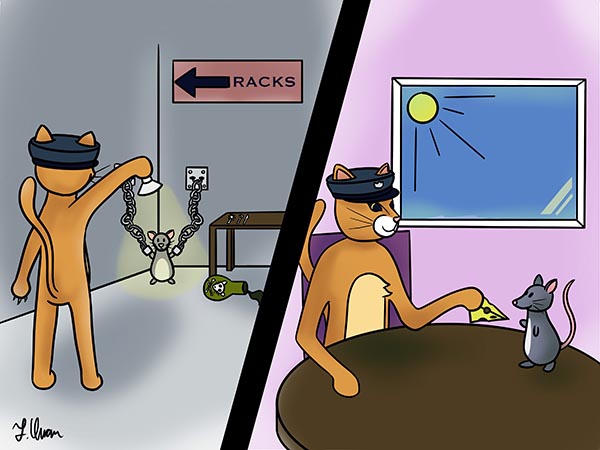
Cartoon depicting a police officer as a cat shining a light on a mouse chained in a room vs. cat in a window-lit room giving a mouse a piece of cheese at a table.

Environments of Justice: Reimagining Interrogation Rooms

In this episode of Proof Over Precedent, HLS student Spencer Thieme discusses interrogation rooms and the effect of a physical environment on stress, memory, disclosure, and false confessions. She also considers potential randomized controlled trials for studying interrogation room design.

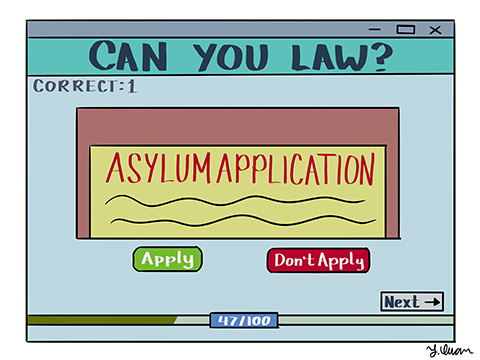
Cartoon depicting a multiple-choice case test for lawyers

Beyond the Bar: Measuring Real-World Legal Judgment

If law could follow medicine to better the field and those working in it, we could see standardized case tests coming to measure lawyers’ decision-making abilities. That’s the argument made by HLS J.D. candidate Michael Pusic in this bonus Proof Over Precedent post. Multiple-choice case evaluations could objectively assess lawyers’ decision-making, improve training and hiring, and determine best use of legal assistance.

Scroll to Top