Civil Court-Based Reforms

Cartoon depicting a police officer taking the shirt off of an individual's back and declaring that it was used in a crime.

Civil Forfeiture’s Access to Justice Problem

File this one under “historic laws in need of modernizing.” Civil forfeiture—the act of seizing and forfeiting physical property, regardless of whether an individual has been charged with a crime — has its roots in customs and piracy cases. But today, in addition to serving as a tool to pad police department’s budgets, it more often keeps cars, cash, and possessions out of the hands of potentially innocent individuals with no guarantee of legal representation. The result is an access to justice failure, as reported by HLS student Joe Liberman in this week’s “Student Voices” blog and podcast episode.

Cartoon depicting a parent and child stuck on a life boat with the S.S. Courthouse boat nearby holding case storage and S.S. Resources boat holding everything the parent and child need (social work, financial help, etc.).

Navigating Unmet Social Needs: A Closer Look at New York Family Courts

In his 2026 State of the Judiciary Address, Hon. Rowan Wilson, Chief Judge of the New York Court of Appeals, took the opportunity to bring attention to one of the state’s most critical access to justice problems: the difficulties families face while navigating New York Family Court. Despite judicial efforts to address families’ underlying social needs, the legislative and executive branches of the state—and in the larger context, the nation—have the responsibility to implement more lasting improvements.

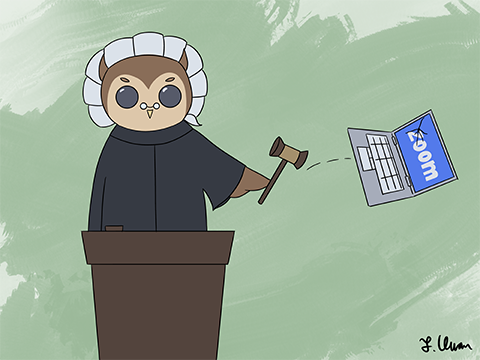
Cartoon depicts inmate waiting to be admitted into a virtual child welfare hearing

Locked Out: Structural Barriers to the Child Welfare System for Incarcerated Parents

For a child, parental incarceration is a legal gateway into the child welfare system. Parents have rights to participate in custody proceedings, but incarceration erects barriers that can make meaningful participation difficult. In this “Student Voices” post, we look at the current system–one in eight incarcerated parents lose their parental rights–and potential solutions to these barriers that, if left unchecked, can effectively lock incarcerated parents out of the child welfare process.

Cartoon depicts Child Protection Services as a falling building, with law and medical support helping to save a family

Inside CHAMPS’ Evidence-Based Holistic Approach to Child Advocacy

This is the story of a traditional law school clinic that has evolved into much more. CHAMPS, the Carolina Health Advocacy Medical–Legal Partnership, is a legal service provider embedded in a healthcare setting. It’s also the field partner for an A2J Lab study evaluating whether legal partnerships can reduce downstream involvement by child welfare agencies in cases potentially due to poverty-related conditions.

Cartoon depicting an individual looking for specialized mental health court support but finding it closed to civil defendants

The Case for a Specialized Civil Mental Health Court

While specialized “problem-solving” courts have become common, there is still no equivalent civil mental health court in Massachusetts to handle complex issues like civil commitment and involuntary psychiatric treatment. The gap exposes the potential for the Commonwealth to learn from other states leading reform of the civil judicial system in this area and to pilot such a court and evaluate its impact through a randomized controlled trial.

Cartoon depicting legal delays for involuntarily committed psychiatric patients with schizophrenia seeking treatment in Massachusetts

Involuntarily Committed Patients Face Legal Obstacles, Treatment Delays

In Massachusetts, involuntarily committed psychiatric patients with schizophrenia often face systemic barriers to timely treatment from procedural inefficiencies that prioritize legal formalities over patient well-being.  To address this access to justice challenge, the Commonwealth could implement reforms to streamline the legal process while preserving patient rights.

Cartoon depicting website navigation as searching for a needle in a haystack

Government Websites: Why are They so Bad (and Can They be Better)?

Government websites, when effective, can make the process of filing for bankruptcy, divorce, restraining orders and other common legal requests easier. Unfortunately, the quality of these websites varies significantly with many state and federal sites’ lack of accessibility reflecting limited access to justice for their users. Fixing these websites is a relatively easy and inexpensive method to expand accessibility to court systems and services, provided the willpower is there. 

Cartoon depicting a lawyer shown as a wolf evicting the Statue of Liberty and replacing her with Uncle Sam

Who Deserves a Lawyer? The Hidden Gender Bias in the Right to Counsel

The landmark court decision in Gideon v. Wainwright from 1963 made it a constitutional right, both in federal and state courts, for criminal defendants to have the right to counsel. That decision does not extend to civil cases– such as child custody, eviction, and domestic violences cases–which affect women, often from marginalized backgrounds, more than than men. HLS student Laura Aquino argues for a study to address the gender bias in denying legal assistance to civil litigants that may play a role in preserving a system that limits access to justice for women.

Cartoon depicting three little pics trying to avoid eviction from the wolf

Legal Literacy: An Upstream Eviction Prevention Strategy

With this housing insecurity having potentially numerous contributing factors, the Access to Justice Lab and research partners at the University of Houston Law Center targeted legal literacy as a potential key to addressing housing evictions in its recently completed pilot study.

Scroll to Top