

By Julia Saltzman, J.D. candidate, Harvard Law School
STUDENT VOICES: The views expressed below are those of the student author and do not necessarily reflect the position of the Access to Justice Lab.
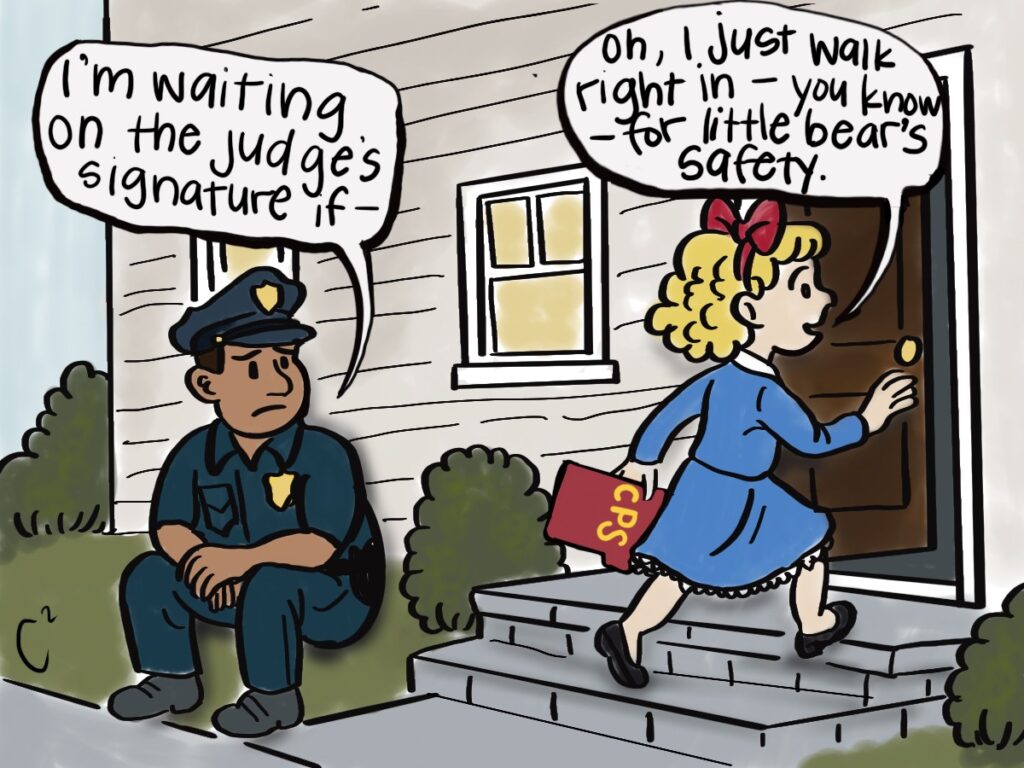
In 2023, Texas passed a law requiring its state agency tasked with investigating allegations of child mistreatment—the Texas Department of Family and Protective Services (DFPS)—to inform parents under investigation of their due process rights. Advocates behind the passage of the law hope it will increase parents’ awareness of their rights and prevent unnecessary DFPS intervention in families’ lives. Family advocates also hope that the new law will benefit Black, Hispanic, and low-income families whom the family regulation system disproportionately investigates.
These warnings have been labeled “Family Miranda warnings,” drawing a parallel to the 1966 criminal procedure Supreme Court case Miranda vs. Arizona, which requires law enforcement officers to warn suspects in custodial interrogations of their rights, including their rights to remain silent and have an attorney present. Evidence-based research evaluating the impact of Family Miranda warnings could help guide states considering enacting similar legislation.
The Issue
Families facing investigations by a family regulation agency “often find little difference between a caseworker and a cop.” One parent described her experience by saying “they treat us as less than human.” Some research supports claims that the investigation process alone can be traumatic for families.
Family regulation agency caseworkers inspect the homes of approximately 3.5 million children annually. An estimated 37% of all children will experience an investigation at some point during their childhood. The vast majority of allegations of child mistreatment are ultimately unsubstantiated: in FY2022, only 18% of allegations were sustained. Seventy-four percent of those substantiations were due to neglect, which is often difficult to separate from family poverty, rather than abuse.
Caseworkers may perform extensive home searches and invasive interviews of children and other family members even if the allegations of neglect stem from children missing school or otherwise are unrelated to home conditions. Some caseworkers, families, and attorneys report that family regulation agencies may use coercive tactics, such as threatening to call the police should a family prevent the agency from entering their home. Once inside, investigators may rummage through the family’s home or even strip search children to look for bruises.
What the Family Miranda Law Does
Under the new Texas law, caseworkers must inform parents verbally and in writing of several key rights when initially making contact as part of a DFPS investigation. The parent has the right to refuse to speak to the caseworker without legal counsel, the right to deny entry should DFPS lack a court order, and the right to a court-appointed attorney (if the parent is indigent and DFPS has obtained a specific court order available in emergency situations). The DFPS caseworker must also provide a brief written summary of the allegations against the parent. If the parent does not receive the warning, any information gathered by DFPS in their subsequent investigation cannot be admitted in a subsequent civil proceeding, including proceedings to place children in foster care or terminate parental rights.
How Texas Passed a Family Miranda Law
Calls to pass a Family Miranda gained momentum in the last several years. Washington has had a version in place since 2005, though it lacks the comprehensive due process protections provided by Texas’s new law. New York failed to pass a similar measure.
Advocates in New York included parent organizers whom the family regulation system had affected as well as organizations advocating for the rights of children. A member of the latter group stated that “the failure to advise parents of their rights often results in confusion and panic for both the adults and children involved.” Supporters of a Family Miranda also argue its protections are required by the Fourth Amendment, which prohibits unreasonable searches and seizures by the government. They hope that increased transparency will lessen the trauma of investigations and improve relationships between parents and caseworkers, as parents better understand how their information may be used.
The primary concern expressed by opponents, including child welfare professionals, was that requiring a Family Miranda warning may delay interventions in dangerous situations. Opponents also worry that providing warnings makes the process unnecessarily adversarial and stymies a caseworker’s ability to connect with the family.
Though state-wide legislation failed, New York City launched a small-scale pilot program to inform parents in certain neighborhoods of their rights by providing them with an informational card. New York City subsequently expanded the initiative city-wide, stating that it was intended as part of the city’s efforts to reduce the child welfare system’s racial disparities.
The legislation passed in Texas because of its bipartisan support, including advocacy from both family defense attorneys and a libertarian-leaning think tank. Both wings emphasized that the warning does not create additional rights but simply ensures parents are aware of the rights they already have— due process rights that protect their fundamental right to a parent-child relationship.
Proposed Further Research
Further evaluation of the potential impacts of a Family Miranda is necessary. More robust research could help parent advocates, family regulation agencies, and policymakers better understand how providing a warning impacts families. One option is for researchers to conduct a study using synthetic controls analyzing the impacts of the new Texas Family Miranda before and after implementation, drawing in part from the pre-existing data that DFPS maintains. Another possible option that could permit researchers to answer a broader set of questions is to conduct a RCT in states that have not yet passed Family Miranda laws. A randomly selected portion of families interacting with family regulation agencies could receive warnings while the other half continues as business-as-usual. Potential research questions to evaluate the effectiveness of Family-Miranda include:
- Does the warning reduce future reports of child mistreatment?
- Does it lead to fewer unsubstantiated allegations?
- Do caseworkers and parents report their relationships become less adversarial?
However, the most important set of questions for researchers to explore is whether parents feel a greater sense of fairness, knowledge, and empowerment during their interactions with the family regulation system, or in other words, whether the warnings measurably increase due process protections. Experience with the original, criminal Miranda supports the need for investigation. Some research suggests that criminal Miranda warnings did not lead to lower rates of confessions, but they did raise public awareness of constitutional rights as the warning became a ubiquitous piece of American culture. That said, other research suggested that people who can recite the Miranda warning do not have a complete understanding of their rights.
Collecting information on the effects of a Family Miranda should involve a combination of interviews and surveys of parents and other stakeholders, as well as close analysis of how families interact with the family regulation system over time. This potential research may help assess claims that providing parents with information about their rights is essential to protecting due process and ensuring access to justice.