

By Leeann Poarch, J.D. candidate, Harvard Law School
STUDENT VOICES: The views expressed below are those of the student author and do not necessarily reflect the position of the Access to Justice Lab.
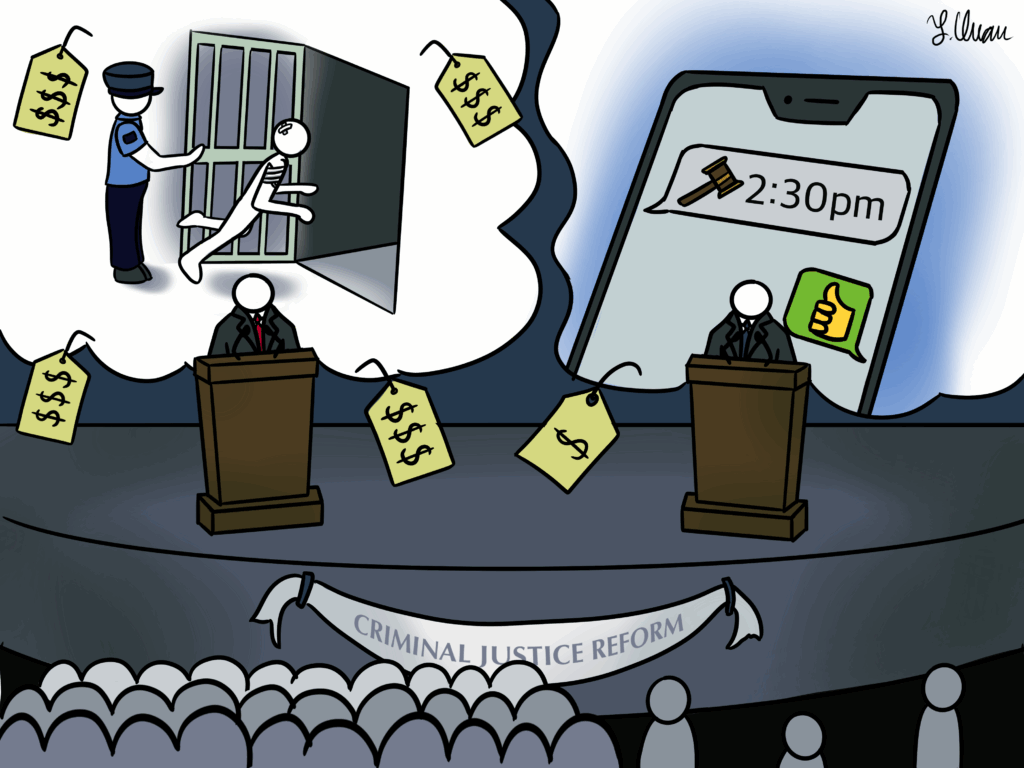
From Nixon’s “War on Drugs” in the 1970s to Reagan’s expansion of the criminal justice system in the 1980s, to Clinton’s 1994 Crime Bill, the narrative of being “tough on crime” periodically takes hold of American politics. “Tough on crime” has been far from just a narrative—since the 1980s, the U.S. jail population has more than tripled. Traditionally, the main role of jails was to confine people convicted of minor crimes, but the number of people in jail for that reason has decreased in the last two decades. The main driver of jail population growth is the increase in the number of people held pretrial, meaning absent a conviction. Those detained pretrial are considered innocent under the law, and pretrial detention was historically restricted to people who posed a flight risk or whose freedom was an unusual threat to public safety. Since the Reagan era, however, several things have changed. For example, alterations in police strategy over the last three decades have meant that interactions with law enforcement are more likely to result in arrest. Increased reliance on money bail means that the criminal justice system has imposed a wealth-based test on freedom. (No doubt there have been other contributors to the growth in pre-conviction detention.) The following question is worth considering: does pretrial detention work? This blog post will focus on two outcomes: failure to appear (FTA) and new criminal activity (NCA). The evidence shows that for both, on average, pretrial detention is for the most part either ineffective or unnecessary, or sometimes both.
Pretrial Detention May Not Be an Effective Deterrent
When judges decide to detain an individual pretrial, their primary legal justification is deterrence. “Deterrence” here is a partial misnomer. Pretrial incarceration operates at least to some extent via incapacitation, not deterrence. Someone incarcerated pretrial cannot voluntarily fail to appear because they do not control their own whereabouts, and incarceration makes NCA harder. That said, many defenses of pretrial incarceration speak the language of deterrence, and certainly deterrence thinking underlies the bail system.
In addition to raising individual liberty concerns, pretrial detention is costly. It is therefore worth considering whether its effects of pretrial detention on FTA and NCA justify the large cost it imposes on society. The evidence suggests that the costs are not justified.
A study by Holsinger, Lowenkamp, and Pratt examined 1,487,107 individuals booked into a jail in Kentucky between 2009 and 2018. There was no statistically significant evidence of a consistent or reliable “deterrent effect” (their term) of pretrial detention on either FTA or NCA. The authors suggest that this finding shows that the deterrence theory is exaggerated.
A 2013 study suggests that pretrial detention is associated with a 30% increase in new felony charges within 18 months post-release. The authors argued that increased likelihood of rearrest stemmed from the fact that incarceration can cut detainees off from prosocial attachments to their jobs or social relationships. This severance tends to increase the likelihood of reoffending. While people are incarcerated, any criminogenic needs that detention does not address, such as deviant peer influences and antisocial attitudes, may increase the likelihood of rearrest.
Dobbie, Goldin, and Yang conducted a quasi-randomized study that found pretrial detention first decreases, then increases NCA, and that after two years, the effects cancel each other out. To explain, these authors spoke in terms of pretrial release, the flipside of incarceration. They asserted that while initial release increases the likelihood of NCA prior to case disposition by 18.9 percentage points, it also decreases the likelihood of NCA following case disposition by 12.1 percentage points. Examining the whole of the two-year period after the bail hearing (typically the first hearing at which the judiciary takes a non-trivial look at an arrestee’s pretrial status), there was no overall effect on NCA. Again, the evidence suggests that pretrial detention does not lower the rate of crime.
Measures Cheaper Than Detention Might be Equally Effective at Controlling FTA
Pugh v. Rainwater once stated that money bond’s lawful purpose is not to protect public safety, but only to provide assurance that a released defendant will return to court. This is no longer the law in all jurisdictions, and legislatures may constitutionally instruct judges to consider other factors, but FTA remains central to the justification for pretrial detention. Doobie et. al. found that pretrial release did in fact increase the probability of FTA by 15.6 percentage points.
Nevertheless, measures other than pretrial detention may address the FTA problem. To begin, the phrase “failure to appear” implies intentional flight by the defendant, but the reality is often more mundane. Lack of transportation, work conflicts, childcare obligations, and confusion around scheduling are all common reasons why defendants fail to appear in court. Vulnerable populations such as people experiencing homelessness or mental illness also struggle with all appointments, including judicial ones. These facts suggest that interventions addressing the mundane causes of FTA might succeed. Experience and evidence support this suggestion.
Tulsa County in Oklahoma faced a budget crisis due to rising incarceration rates. Of people detained in the Tulsa County Jail, 14% were there for FTA, resulting in nearly $1.2 million in jail costs. To try to reduce FTA, Tulsa County partnered with a vendor called Uptrust to implement a messaging tool to provide reminders, to facilitate transportation, and to connect clients to a case manager. Prior to retaining Uptrust, Tulsa County rarely reminded people about upcoming court dates. The system Uptrust implemented was not perfect. Access to technology remained an issue for public defendant clients, but the results of Uptrust in Tulsa in its first year were promising. Although Tulsa County did not measure a baseline FTA rate before implementing Uptrust, stakeholders credited its app with significantly reducing FTAs. One stakeholder noted that before Uptrust, “50% of clients didn’t show, now it’s about 15%.” Perhaps most importantly, defendants gave Uptrust high marks, showing appreciation for the reminders and services available through the app.
The Tulsa experience generalizes. Seemingly minor, low-cost reforms, such as sending defendants reminders in the form of mail, phone call, or text message notifications, can reduce FTA rates. The available research shows that phone-call reminders can increase appearance rates by as much as 42%, and mail reminders can increase appearance rates by as much as 33%. Excluding start-up costs, sending three reminder texts costs about 3 cents per court date. For every court date that is attended, the analysis firm ideas42 (yes, the name comes from where you think it does) estimated that the government saves $2,674 in costs including those of issuing a warrant, arresting, booking, and jailing a person; holding additional hearings; paying attorneys; and/or implementing pretrial supervision. The firm estimated that effective court communication in an average sized state would equate to about 28,137 additional misdemeanor court dates attended and social benefit of $75 million per year.
Releasing Defendants Pretrial May Not Negatively Impact Public Safety
Some argue that a shift away from pretrial detention puts community safety at risk. The Prison Policy Initiative examined the effect of pretrial reform on public safety in 13 jurisdictions. The study found that whether a jurisdiction’s reform was eliminating money bail, using a validated risk assessment tool, or introducing services to remind people of upcoming court dates, the results were the same: releasing people pretrial did not negatively impact public safety.
In 2017, New Jersey passed a law implementing a risk-informed approach to pretrial release and virtually eliminated the use of cash bail. From 2016 to 2018, the pretrial population decreased by 50% (the COVID-19 pandemic increased the population of pretrial incarceration so that pretrial incarceration in 2023 was only 25% below what they were in 2015). Violent crime in New Jersey decreased: homicide fell by 32%, rape decreased by 13%, robbery decreased by 37% and burglary decreased by 30%.
A 2016 constitutional amendment in New Mexico prohibited judges from imposing bail amounts that people could not afford. It enabled the release of many low-risk defendants without bond and allowed defendants to request relief from the requirement to post bond. Crime rates in New Mexico declined after the reform took effect in 2018. The number of people released pretrial who were not charged with committing a new crime increased from 74% to 83%.
In response to the data from the impact of state level reforms, the Heritage Foundation acknowledged a need for pretrial measures concentrated on objective, data-driven ideas—not ideological or political goals—to improve the administration of justice without compromising public safety. This statement showed recognition of the issues surrounding pretrial detention among conservative researchers, those often (perhaps wrongly) associated with vocal support for “tough on crime” policies. Koch Industries also celebrated an effort in Texas to keep individuals who did not threaten public safety out of prison through alternative methods such as specialty courts and probation, expressing a need for more reform that is “smart-on-crime, soft-on-taxpayers.”
While the empirics raise doubt that pretrial detention has a significant impact on improving public safety, it is hard to understate the effect of public perception and politics on criminal justice reform. “Tough on crime” is a narrative that sells politically. A 2023 Gallup survey found that 58% of Americans think the U.S. criminal justice system is not tough enough in its handling of crime. When asked which should be the greater priority for the U.S. criminal justice system today, 55% of Americans favored “strengthening law and order” through more police and greater enforcement of the laws over reforming court and police practices. One wonders whether the public would think the same way if some of the evidence summarized in this blog post was better known.
If you’re interested in more on this topic, listen to our Proof Over Precedent podcast episode, or read the first Proof Over Precedent blog on the economic and social costs of pretrial detention.