Familial Relationships

Cartoon depicting a parent and child stuck on a life boat with the S.S. Courthouse boat nearby holding case storage and S.S. Resources boat holding everything the parent and child need (social work, financial help, etc.).

Navigating Unmet Social Needs: A Closer Look at New York Family Courts

In his 2026 State of the Judiciary Address, Hon. Rowan Wilson, Chief Judge of the New York Court of Appeals, took the opportunity to bring attention to one of the state’s most critical access to justice problems: the difficulties families face while navigating New York Family Court. Despite judicial efforts to address families’ underlying social needs, the legislative and executive branches of the state—and in the larger context, the nation—have the responsibility to implement more lasting improvements.

Cartoon depicts inmate waiting to be admitted into a virtual child welfare hearing

Locked Out: Structural Barriers to the Child Welfare System for Incarcerated Parents

For a child, parental incarceration is a legal gateway into the child welfare system. Parents have rights to participate in custody proceedings, but incarceration erects barriers that can make meaningful participation difficult. In this “Student Voices” post, we look at the current system–one in eight incarcerated parents lose their parental rights–and potential solutions to these barriers that, if left unchecked, can effectively lock incarcerated parents out of the child welfare process.

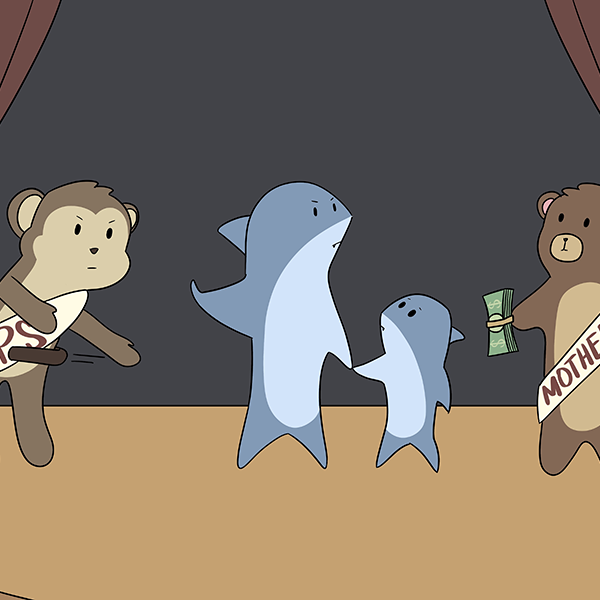
Cartoon depicting a mother and child on a stage between a bear representing Mother Up and holding cash out to them and a monkey representing Child Protection Services and being pulled off the stage.

Turning Proof into Policy: Evidence for Guaranteed Income to Support Black Mothers

The Mother Up project has grown from a small six-person study to the expanded and currently enrolling Phase III study now underway. Throughout, Mother’s Outreach Network has been building evidence to show that financial support, in addition to a network of social and legal help, can help Black mothers avoid entanglement with child welfare agencies. The leader of the organization offers her vision on the project and reaction to the results so far.

Cartoon depicting Mothers Outreach Network (as a bear) giving money to a mother and child (drawn as horses) to buy (horse) shoes.

Testing the Poverty-Child Welfare Connection: Pre-Pilot Study Explores Guaranteed Income

The “Mother Up” pre-pilot program is an evaluation of a guaranteed income project targeting Black mothers in Washington, DC, who are in danger of getting involved with the child welfare system. Studying the efficacy of the program provided the A2J Lab with enough solid data to pursue it on a larger scale and bring an evidence-based voice to the discussion on poverty’s link to child welfare.

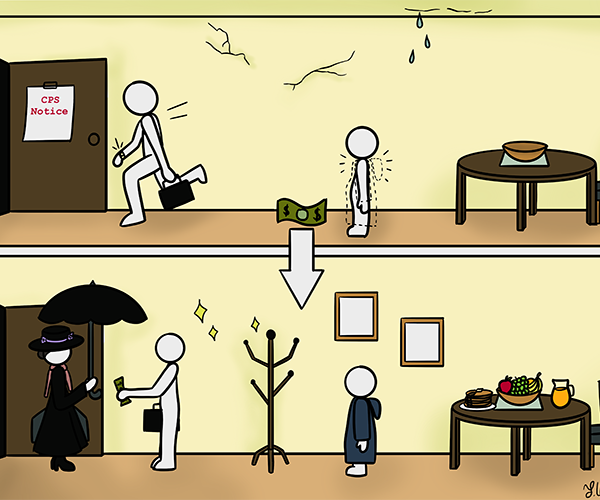
Cartoon comparing a household of neglect due to poverty vs. a household with a little more money running smoothly.

At the Poverty Line: Is Money the Root of Family Stability?

Eight hundred families in Illinois–and the researchers working with them–are about to find out. With monthly cash gifts of varying denominations dependent on family size and local cost of living, participants of the EmPwR Study will gain firsthand knowledge of whether a year of guaranteed income will stave off child welfare involvement. HLS J.D. candidate Julia Saltzman examines the relationship between poverty and family regulation system involvement and shares details on the randomized controlled trial taking place in urban, suburban, and rural communities in Illinois.

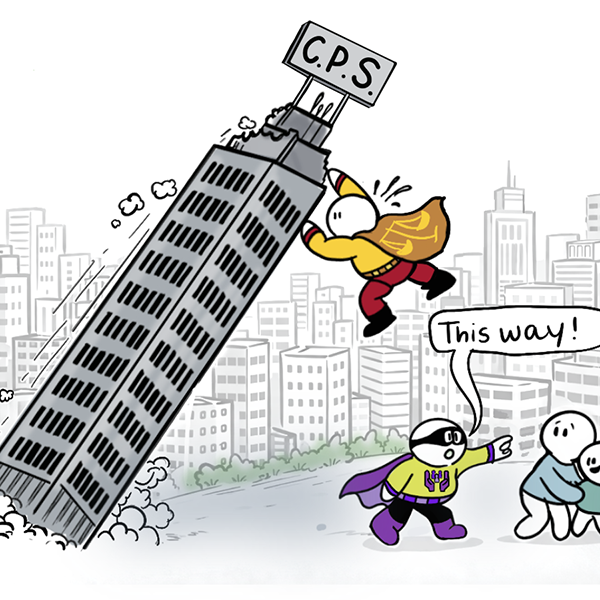
Cartoon depicts Child Protection Services as a falling building, with law and medical support helping to save a family

Inside CHAMPS’ Evidence-Based Holistic Approach to Child Advocacy

This is the story of a traditional law school clinic that has evolved into much more. CHAMPS, the Carolina Health Advocacy Medical–Legal Partnership, is a legal service provider embedded in a healthcare setting. It’s also the field partner for an A2J Lab study evaluating whether legal partnerships can reduce downstream involvement by child welfare agencies in cases potentially due to poverty-related conditions.

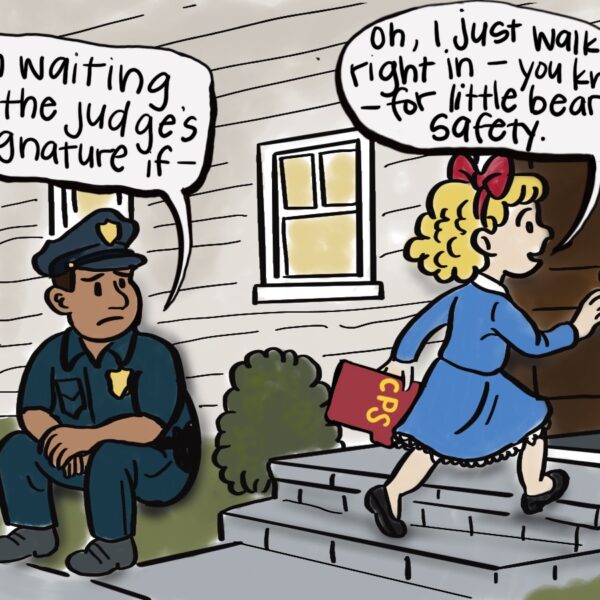
Cartoon depicting a child welfare agent entering a home, without a judge's order, in the name of children's safety

Family Miranda: Expanding Due Process Rights to Child Welfare Investigations

Texas’s 2023 “Family Miranda” law requires child welfare investigators to inform parents of their due process rights at the beginning of an investigation. The intent is to reduce unnecessary state intervention, trauma, and coercion. The law passed with bipartisan support and ultimately clarifies existing law, rather than creates new law. In this “Student Voices” blog, HLS student Julia Saltzman calls for a randomized controlled trial to determine the efficacy of the law in improving fairness and reducing unnecessary interventions.

Cartoon depicting an outdated mandate requiring a typewriter in order to file for divorce

Unveiling the Complexity: Divorce and Access to Justice

Marriage in the U.S. typically requires a marriage license, payment of a nominal fee, and often a short waiting period from the license signing to marriage. Divorce, on the other hand, typically involves lawyers; courthouse visits; comparatively higher fees; and, in some cases, antiquated roadblocks just to implement this federal constitutional right. The result is that divorce can be an access-to-justice issue for low-income individuals who are faced with trying to pay for a lawyer they cannot afford or navigate unnecessarily complex divorce filing procedures on their own.  

graphic of hands with symbols of necessities

Mother Up Study Links Child Neglect, Poverty, and Guaranteed Income

The Access to Justice Lab published a newly released study of Washington, D.C. mothers involved in Child Protective Services demonstrating that government-funded child welfare programs are effective in reducing child neglect cases by prioritizing economic support to overcome conditions caused by poverty.

Cartoon depicting a lawyer shown as a wolf evicting the Statue of Liberty and replacing her with Uncle Sam

Who Deserves a Lawyer? The Hidden Gender Bias in the Right to Counsel

The landmark court decision in Gideon v. Wainwright from 1963 made it a constitutional right, both in federal and state courts, for criminal defendants to have the right to counsel. That decision does not extend to civil cases– such as child custody, eviction, and domestic violences cases–which affect women, often from marginalized backgrounds, more than than men. HLS student Laura Aquino argues for a study to address the gender bias in denying legal assistance to civil litigants that may play a role in preserving a system that limits access to justice for women.

Scroll to Top