

By Aarushi Solanki, J.D. candidate, Harvard Law School
STUDENT VOICES: The views expressed below are those of the student author and do not necessarily reflect the position of the Access to Justice Lab.
Specialized Courts
In 1989, Miami pioneered an approach to court management that addressed the needs of a specific population—those with substance use disorders. This drug court was the first of what are now called “problem-solving” courts. Problem-solving courts use their authority to forge novel responses to socio-legal problems. They aim not only to adjudicate but also to collaborate and to alter future behavior of litigants. Social services agencies often help problem-solving courts achieve their aims.
According to the National Institute of Justice, the goals of these courts are two-fold: (1) case management and (2) therapeutic jurisprudence. Case management is intended to “expedite case processing and reduce caseload and time to disposition, thus increasing trial capacity for more serious crimes.” Therapeutic jurisprudence draws from psychological research to make the legal system more rehabilitative. Rehabilitative approaches include emphasizing treatment and adopting less adversarial forms of litigation. In addition to drug courts, other examples of specialized courts include veterans courts, domestic violence courts, and mental health courts.
Mental Health Courts
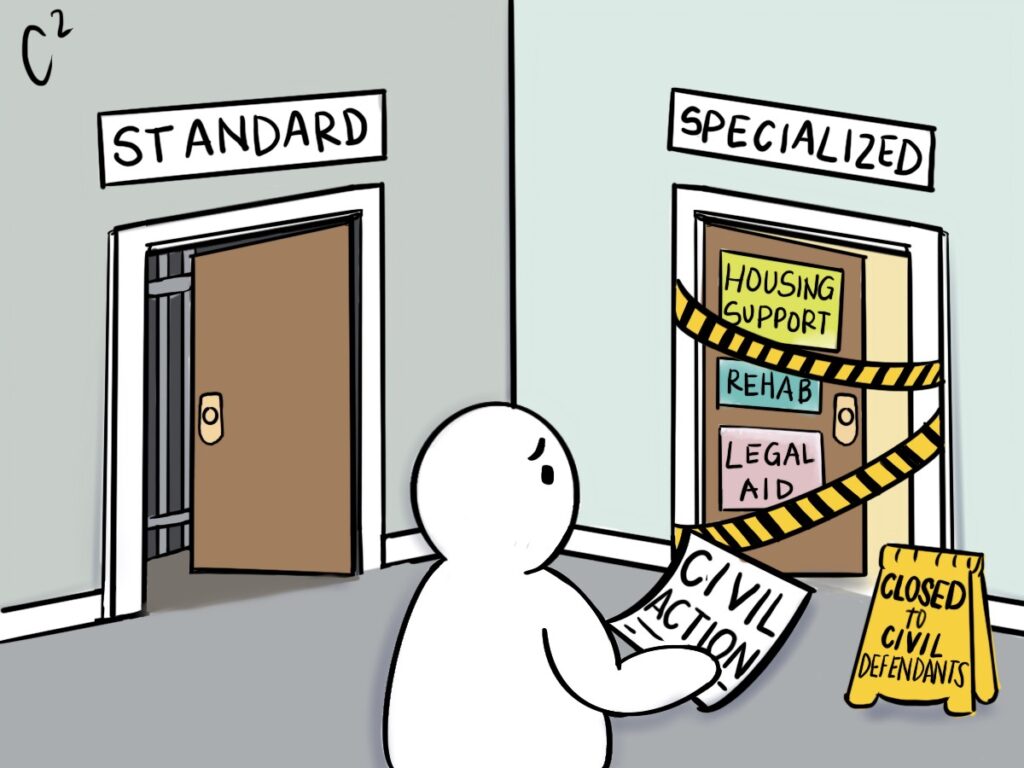
Mental health courts (MHCs) exist almost exclusively in the criminal context. While their characteristics vary across jurisdictions, these courts generally divert eligible and willing defendants from incarceration to treatment. MHCs in Massachusetts usually serve individuals who have been deemed competent to stand trial, have resolved their criminal cases through a guilty plea or admission to sufficient facts, and have been placed on pre-trial or post-disposition probation. Some MHCs “will accept defendants pre-trial with untried open matters.” MHCs connect consenting participants to community-based mental health treatment as well as support for housing, education, and employment. In theory, participants would experience improved mental health and reduced interactions with the criminal justice system. But RCTs in this area are rare, as Lowder et al. pointed out in their meta-analysis examining MHC participant outcomes. In Massachusetts, the number of MHCs has increased from a handful to sixteen in recent years “and will likely continue to grow.”
But in the civil context—where liberty and treatment decisions are similarly at stake for individuals with serious mental illness—specialized courts remain absent. Instead, states like Massachusetts rely on general trial courts to adjudicate complex issues such as civil commitment (during commitment hearings) and, if the civilly committed individual has refused treatment, accompanying involuntary psychiatric treatment (during Rogers hearings). As I explained in my first and second blog posts, this traditional model often produces (1) inefficiency, as evidenced by lengthy delays to the conclusion of Rogers hearings and administration of treatment, and (2) lack of oversight, as evidenced by judges nearly always approving treatment plans, which raises the possibility that the aforementioned delays are meaningless. These issues should be concerning. Patients can experience physical and psychological harm during prolonged institutionalization without treatment. In my second post, I explored remedying efficiency and effectiveness through two proposed reforms—substituting administrative law judges for trial judges and appointing mental health professionals in place of CPCS attorneys.
Here, I propose going a step further: creating formal, specialized civil mental health courts. My previous post focused on rethinking the roles of key actors, and those proposals centered around an administrative hearing model, which is typically less formal, non-adversarial, and procedurally distinct from traditional courts. While such reforms may mitigate some of the inefficiency and ineffectiveness that the traditional process entails, research suggests that “informal procedures and nonlegal decisionmakers” may leave patients “with perceptions of unfairness, [which causes increased] resistan[ce] to the treatment they are compelled to endure.” This post seeks to address that tension—between the perceived procedural justice of formal proceedings and the pragmatic appeal of administrative efficiency and experts’ effectiveness—by calling for reform within the civil judicial system. The creation of specialized civil mental health courts could retain formal judicial processes but enhance them with subject-matter expertise, procedural consolidation, and built-in supports such as patient-designated allies and psychiatric advance directives.
Pioneers: The CARE Courts
California’s recent implementation of Community Assistance, Recovery and Empowerment (CARE) Courts—which serve individuals with schizophrenia spectrum and other psychotic disorders—provides a compelling proof of concept. These courts determine eligibility for community-based treatment, offering a structured civil pathway that does not rely on prior criminal legal system contact. Massachusetts is one of two states in the country that does not have an analogous community-based treatment system, but its inpatient Rogers hearing process may still benefit from copying aspects of CARE Courts and criminal MHCs.
One lesson Massachusetts’ legislature can learn from the CARE Act to address inefficiency is the importance of setting a time limit on the clinical evaluation hearing. During this hearing, the court evaluates whether the individual has a qualifying clinical diagnosis and is competent to give informed consent to medication. The court also considers information relevant to the determination of appropriate care and treatment to approve plans proposed by the individual’s CARE team. In this way, the California CARE clinical evaluation hearing is akin to a Massachusetts Rogers hearing, the latter of which also involves a determination of competency and, if the individual is found incompetent, of the appropriateness of the psychiatrist’s proposed treatment plan. But the CARE Act mandates a “maximum of 14 days” for the treatment hearing, unless “good cause” is shown for an extension. The Massachusetts statute governing Rogers hearings imposes no comparable time constraint. While Massachusetts district court guidelines include a requirement akin to good cause for a continuance (court-ordered delay), 25% of the continuances granted in a recent study offered no reason for the continuance request. If the Massachusetts guideline is incorporated into the relevant statute, the newfound illegality of the current process may increase pressure on facilities and courts to reduce delays that patients experience.
Massachusetts could benefit from another CARE Courts innovation, namely, the designation of a “supporter” during hearings who “help[s] the participant understand, consider, and communicate decisions, giving the participant the tools to make self-direct choices to the greatest extent possible.” Having this assistance may enable CARE participants to communicate directly with the judge—which, as with a judge’s respect for the individual, is associated with increased perceptions of procedural justice. In the Rogers hearing context, a supporter could be subject to a professional mental health training requirement. My last blog post proposed—just as Justice Powell suggested in his Vitek v. Jones concurrence—replacing patients’ attorneys with mental health professionals, who might advocate more effectively for patients in such contexts. Currently, the effectiveness of patients’ counsel rests upon their the ability to interpret psychiatric evaluations. The CARE Courts’ supporter model, coupled with a requirement of professional mental health training, offers a compromise between adversarial legal representation and total clinical paternalism.
California’s CARE Act also presents participants with the opportunity to complete an Advanced Psychiatric Directive. In my first blog post, I pointed out that autonomy concerns in end-of-life medical decisions can be avoided in Massachusetts through Advance Directives, in which individuals specify what actions should be taken for their health when they are too ill or incapacitated to consent. Similar autonomy concerns underly involuntary psychiatric care, yet Psychiatric Advanced Directives (PADs) do not have the force of law in Massachusetts despite attempts in the state legislature to correct the issue.
The empirical evidence on PADs is surprisingly abundant, at least when compared to that on MHCs. One study found, perhaps unsurprisingly, that PADs correlated with decreased patient perceptions of coerciveness during care. The PADs in this study “typically contained advance consent to hospitalization; indicated a preference for specific medications over others; and included advice to inpatient staff about how to help them avoid the use of physical restraints and seclusion during a future mental health crisis.” Specialized civil mental health courts, during their periodic reviews of competency, should be required to encourage the completion of PADs when individuals are found competent.
Conclusion
If Massachusetts were to pilot a civil mental health court, an empirical evaluation using an RCT should accompany implementation. Individuals who are involuntarily committed can be randomly assigned to the traditional civil trial court or to a specialized civil court. Because the features of specialized courts differ, some elements to incorporate as experimental variables could include the above innovations by the CARE Court: statutorily mandating a time restriction for treatment hearings; providing a supporter with professional mental health training; and emphasizing the completion of PADs. By credibly testing these reforms, Massachusetts could become a leader in building a just, efficient, and therapeutic civil mental health system.