

By Michelle Blouin, Communications Associate, Access to Justice Lab, Harvard Law School
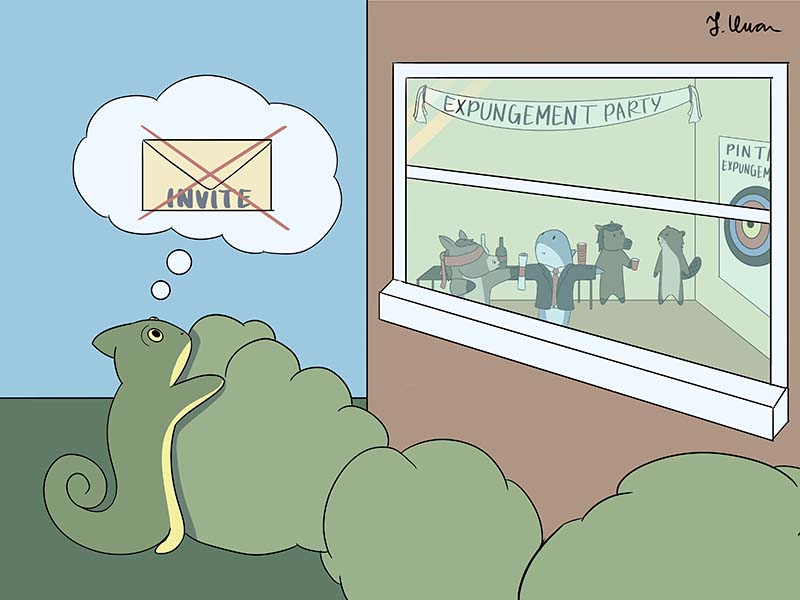
What if thousands, perhaps millions, of people could stop their past—their criminal record, that is—from following them in job interviews and housing applications? Our earlier Proof of Precedent blog pointed out that roughly a third of U.S. adults have pesky misdemeanors or more serious felony convictions on record. The “second-chance gap” means that, at most, only 20 percent of these individuals with records that could be cleared through expungement actually do get them cleared. Reasons range from financial burdens to time-consuming procedures, lack of information, distrust in the legal system, and lack of legal help. What if some barriers to record clearing could be improved by policy, and not by an individual’s circumstances? Would that improve uptake in expungement? A 2025 article in the North Dakota Law Review, “Criminal Justice Record Clearing: An Analysis from Two States,” addresses the possibilities by examining the current state of record clearing in Pennsylvania and Kansas and potential policy reforms in both states that would produce the greatest number of eligible records for clearing.
The Research
The research, outlined in depth in the North Dakota Law Review article, is the work of A2J Lab Faculty Director D. James Greiner, A2J Lab Research Director Renee Danser, and former A2J Lab researcher Matthew Stubenberg. The three collaborated on data analyzed from four counties in Pennsylvania and 29 localities in Kansas. The two states differ in their approach to record clearing. Pennsylvania automatically seals eligible records without any action required by the individual, per its Clean Slate Act implemented in 2019. Kansas law allows only for petition-based record clearing, requiring the individual to do the work of applying for expungement.
The research presented in the article relies on predictive modeling to tweak variables of existing data in order to see how legislative changes could impact expungement eligibility and accessibility. This kind of research is unique, Stubenberg noted, because this kind of data doesn’t exist. “Hopefully this will be kind of the start of analyzing this big data to be able to give policymakers and legislators a little bit more information on the impact of their decision.”
State of the Data
When the researchers amassed information from both states, they found data integrity became a consistent and troubling issue.
In Pennsylvania, the Clean Slate Act automatically sealed more than 30 million eligible, nonviolent records in the first year of its passage. The researchers, however, found about 200,000 charges that should have been sealed by law but were still publicly available. They noted evidence of incomplete data transfers from paper to electronic records, revealing some eligible records that were never sealed, as well as some records marked with missing or unknown charges, which would impact eligibility for sealing. They also pointed out data migration issues and missing dispositions as further complicating the data inaccuracies that they refer to in the article as “ferocious challenges” in all four counties.
While not relying on data to automatically seal records, Kansas—ideally—should rely on consistent data infrastructure throughout the state. But researchers found that the data system used by Johnson County (the largest in the study) differed from the state-run information portal housing data for the other Kansas localities studied; the systems had different waiting period start dates for individuals to petition for expungement—an inconsistency that would challenge the state’s ability implement an accurate, long-term record-clearing system. They found that of the 255,000 records pulled in the Kansas localities studied, more than half—140,000 total—would have been eligible for expungement if all possible records were petitioned to be cleared.
Data integrity impacted the research, but it further showed that it compromised the ability to have a reliable, efficient record-clearing system as it currently stands. “Because of resource constraints, courts and clerks of courts offices don’t spend a lot of time on auditing their records to ensure that the data is clean,” Danser said in the Proof Over Precedent episode. “This becomes more important when you’re relying on clean data to automate a process.”
Eligibility Impediments
Data integrity aside, the researchers found barriers to record clearing eligibility in both states.
- Waiting Periods: Pennsylvania requires a 10-year waiting period for misdemeanor convictions (which resets if the individual does not remain crime free) before an eligible record may be automatically sealed. The lengthy timeframe often bypasses the most critical time of need in which an individual could benefit from a cleared record. Kansas, by comparison, offers different timeframes for expungement based on the charge category.
- LIFOs: Financial barriers often preclude record clearing eligibility. These LIFOs (legally imposed financial obligations) stem from unpaid fines, fees, or restitution—no payment, no record cleared.
- Subjective Decisions: In its eligibility determination process, Kansas includes the allowance for a judge to decide if expungement is appropriate. With no data behind this subjectivity, this judicial determination allowance becomes a potential eligibility barrier.
- Nuance: Pennsylvania’s Clean Slate Act aims for efficient and automatic record clearing, but the level of nuance in determining those records actually eligible for automatic sealing – without having a potentially disqualifying element—is rather restrictive, the researchers found. This leads to some petition-based expungement despite the Clean Slate Act’s original intent.
Policy Possibilities
The researchers looked at these barriers for record clearing and adjusted them in ways that would improve record clearing eligibility; some adjustments, they acknowledged in the paper, would likely receive political pushback but would be helpful information to have available alongside evolving research in criminal law. Among their data-driven policy recommendations for Pennsylvania and Kansas:
- Data: For effective, efficient, and accurate automatic record sealing in Pennsylvania, the courts need to address data integrity by 1) auditing the data regularly, 2) using an algorithm to adjust records impacted by data issues to be eligible non-convictions, and 3) shifting the burden of filing a petition for each charge from the individual to the local District Attorney or law enforcement office.
- Record-Clearing System: Due to the limitations that petition-based expungements have in increasing the number of records cleared, Kansas should move to an automatic record clearing system.
- Waiting Periods: A reduction in waiting periods for both states would have a huge impact. In Pennsylvania, of the 35,000 eligible charges in Allegheny County (location of Pittsburgh), 14,000 could be sealed if the waiting period were changed to five years. In Kansas, the researchers found the majority of records—more than 150,000—fell into the three-year waiting period, the period for charges such as misdemeanors, traffic infractions, and low-level felonies. Adjusting the waiting period, or eliminating it altogether, for these low-level offenses alone would have a massive impact on the individuals affected and the number of records cleared in the state. “When you couple that with the research that’s still evolving about propensity to commit crime and to be involved in the justice system, it kind of makes sense to make that reduction and it doesn’t seem like it is a political burden,” Danser said.
- LIFOs: Another boost to clearing records could come from easing the associated financial burden required to clear those records. The researchers looked at variations in Pennsylvania that would ease that burden, such as lowering restitution or forgiving it altogether when applied to businesses or organizations (but not individuals), or eliminating fees. One example: removing fees and fines as an eligibility criterion for 70-year-olds and older would impact 4,761 people and clear 17,944 charges.
- Subjective decisions: Since judicial determination allowance is subjective and cannot be backed by data, the researchers advised on removing this practice.
- Nuance: Researchers questioned the need for a high level of nuance in determining eligibility for record sealing in Pennsylvania. They also questioned whether the courts had the auditing capacity to uphold the nuanced law.
When it comes to making changes to legislation, Danser suggested “thinking about the piece of legislation more holistically and making sure we’re not just doing a piecemeal modification that in the long run is going to make it more difficult to actually realize the benefit that we’re attempting to give to the community.”
If you’re interested in more on this topic, listen to our Proof Over Precedent podcast episode.