

By Spencer Thieme, J.D. candidate, Harvard Law School
STUDENT VOICES: The views expressed below are those of the student author and do not necessarily reflect the position of the Access to Justice Lab.
Human rights advocates and academics have been criticizing the Prison Litigation Reform Act (“PLRA”) for decades. They argue the PLRA imposes burdensome constraints on state prisoners, effectively barring them from litigating claims that the conditions or practices of their institutions deprive them of their constitutional rights. Nonetheless, calls for the PLRA to be repealed or amended have been unsuccessful despite statistical evidence that the Act has decreased litigation. Further, the data advocates use to support repeal is often qualitative, i.e., telling stories about the horrible conditions prisoners are unable to fight in court, or outdated, showing the difference in litigation rates before and after the Act’s enactment, now almost thirty years ago. Perhaps a different approach is needed. It may be time to start looking for ways to help prisoners navigate the constraints of the PLRA through expanding access to legal resources. And on a parallel track, efforts to continue the fight for legislative change may benefit from compiling more recent data.
History of the PLRA
President Bill Clinton signed the PLRA into law in 1996. The law’s proponents argued the Act would limit rates of frivolous lawsuits and prevent “overzealous federal courts” from having outsized influence over the operation of state and local facilities. Much of the discussion on the senate floor revolved around a series of seemingly absurd, though largely unrepresentative, civil rights suits that incarcerated litigants brought under §1983. Senator Dole argued that the PLRA would “prevent such grievances as insufficient storage locker space, a defective haircut by a prison barber, the failure of prison officials to invite a prisoner to a pizza party for a departing prison employee, and yes, being served chunky peanut butter instead of the creamy variety.” It might appear from those discussions that the PLRA would only stop litigation that was a sure waste of the court’s time. One of its sponsors, Senator Orrin Hatch emphasized: “no one, of course, is suggesting that prison conditions that actually violate the Constitution should be allowed to persist.”
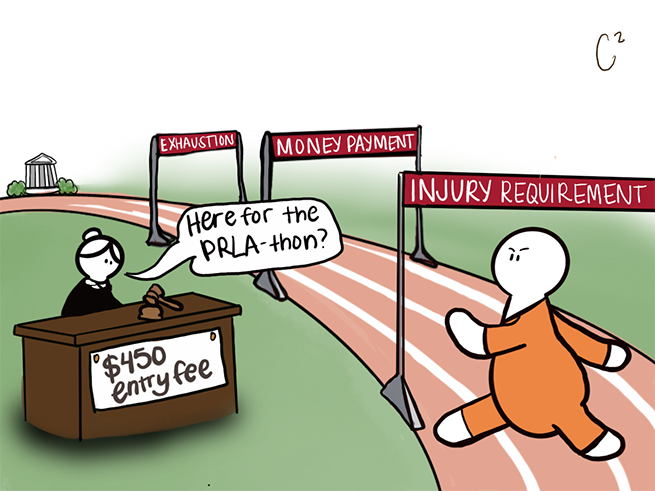
In practice, however, PLRA has limited the ability of incarcerated individuals to access courts on claims with more serious consequences than the types of grievances Senator Dole emphasized. Among these limitations are (1) the administrative exhaustion requirement, (2) the proof of injury requirement, and (3) monetary barriers to effective representation: filing fee requirements and limits on attorney’s fees.
Administrative Exhaustion Requirement
Generally, §1983 claims brought by people outside of the prison system are not required to exhaust administrative remedies to bring an action. The PLRA, however, requires that incarcerated individuals navigate their facilities’ internal remedies before filing a claim in federal court. Although the statutory language only applies to suites filed by prisoners about “prison conditions,” the Supreme Court has interpreted that language broadly as applying “to all inmate suits about prison life, whether they involve general circumstances or particular episodes, and whether they allege excessive force or some other wrong” (emphasis added). This provision is the main reason that prisoners lose their §1983 claims. The PLRA did not standardize what steps prisoners must take before filing. Rather, it leaves the administrative process up to the facilities themselves. It can take months to navigate a facility’s remedies. Even during the COVID-19 pandemic, the exhaustion requirement was not dissolved. Cases can be thrown out under the exhaustion rule for a variety of reasons including filing grievances in one case rather than in separate cases, or using handwritten copies of documents when they lacked access to a photocopier.
Courts are not often sympathetic to arguments that a litigant had difficulty exhausting their internal remedies. Milton Alvarado Benavidez did not speak or read English. He filed a lawsuit alleging that prison neglect caused him to shatter his femur and left him wheelchair bound for two months. The only administrative handbook his prison had was in English. Although the prison did not provide him with a translation, the court held the onus was on him to exhaust those procedures.
Even when an inmate is aware of the administrative procedures available to them, they might have legitimate reasons to not exercise them—an argument to which courts are often similarly unsympathetic. Guards did not intervene when fellow inmates beat 16-year-old Steven Zick to the point of seizure at a juvenile facility. The guards were aware that the beatings continued. In fact, the guards more than condoned the violence—they encouraged it. Sometimes they would arrange fights between the children or handcuff a child to make it easier for the others to attack. While Mr. Zick was aware that he could report their behavior, he was afraid it would cause him to be targeted even more. When he eventually filed suit against those guards, the court system dismissed it for failure to exhaust the prison’s administrative requirements.
Potential Solutions
To help litigants like Mr. Benavidez, a legal aid organization could randomize access to guides explaining a specific prison’s administrative procedures in simple English with translations. They could make these as simple as reasonably possible with checklists and FAQ sections. They could identify prisons with roughly equivalent administrative procedures, handing out the guides to one and not the other. From there, the organization could track how often litigants were able to successfully pass that administrative barrier. This could help the organization determine how effective information alone could be at assisting incarcerated pro se litigants.
Assisting individuals like Mr. Zick would likely require some amount of government action, though it would not necessarily need to be federal. Most state facilities are monitored by individuals who work for the state correctional agencies, creating a potential conflict of interest. States lacking independent oversight could create ombudsman programs, nonpartisan legislative agencies to investigate inmate complaints. People like Mr. Zick might feel more comfortable reporting to an outside agency that could guarantee their anonymity.
Proof of Physical Injury
The injury requirement bars incarcerated individuals from bringing federal civil rights actions “for mental or emotional injury suffered while in custody without a prior showing of physical injury or the commission of a sexual act.” As the D.C. Circuit put it in 2016, the statute “may well present the highest concentration of poor drafting in the smallest number of words in the entire United States Code.” The language is vague. The provision does not clarify how severe a physical injury must be to qualify for recourse, what kinds of head injuries would be considered “physical” as opposed to “mental or emotion,” or whether the “prior showing of physical injury” needs to be connected to the alleged “mental or emotional” injury.
The Southern District of Indiana found that Mr. Ipsy-Israel—who spent eleven years confined alone in a constantly-illuminated cell, during which time he was allowed out of his cell for only an hour a day while in shackles—was unable to recover damages because the court found he sustained no physical injury. Even in cases in which some physical injury can be shown, the courts are split on how significant that injury must be to qualify for recourse. In Siglar v Hightower, the Fifth Circuit drew that line by adopting the Eighth Amendment standards used in excessive force cases: the injury does not have to be significant but must be more than de minimis. While the courts have generally adopted this framework, courts split on how they define “de minimis.” In Luong v. Hatt, the United States District Court for the Northern District of Texas defined de minimis, stating that the injury would have to be something requiring treatment from a medical professional. Luong became the majority approach, followed by the First, Third, Fourth, and Eleventh circuits. The Ninth Circuit has repeatedly held that they “do not subscribe to the reasoning set forth by the Fifth Circuit.” Their approach, per Oliver v. Keller is more lenient. The Court, however, has yet to offer a clear definition of de minimis. Instead, the Ninth Circuit offers examples of what might or might not qualify: painful sleeping arrangements are de minimis, bed sores aren’t.
Potential Solutions
Researchers could randomize providing psychological and neuroscientific evaluations to prisoners before, during, and after different forms of incarceration and track whether and how mental injuries increase violence while incarcerated or rates of recidivism once out of prison. While this data may not help those currently incarcerated, a correlation might persuade legislators and courts that there is a public safety interest in preventing excessive mental or emotional injury to incarcerated individuals. Data could be used to bolster calls to amend or repeal the PLRA.
Monetary Barriers
Incarcerated litigants may bring lawsuits in forma pauperis—to have their fees waived based on their economic status—but, unlike the general population, they would still have to pay a $350 filing fee. That fee is a significant hurdle for almost all prisoners. The $350 sum represents, on average, 248 to 2,500 hours of labor in a prison job, depending on the facility’s location and the nature of their work. The PLRA also caps attorney’s fees. These cases have relatively small payouts (sometimes as little as a dollar), so incarcerated people generally can obtain only pro bono representation on these cases. The majority must represent themselves, usually unsuccessfully. Only 6% of pro se civil rights cases by incarcerated plaintiffs succeed—the lowest of any form of pro se case.
Potential Solutions
Researchers could randomize paying that filing fee for prisoners to see if that impacts the volume, type of claims brought, and success rates. Law firms and legal aid services could randomize how they choose clients for pro bono representation. Either option could serve the dual purpose of helping those currently incarcerated while providing more data on how these barriers may be preventing well-founded claims.
Conclusion
It is important to recognize and criticize legislation that appears to hinder access to justice for vulnerable populations. But when those in power repeatedly ignore such criticisms, it may be worth considering options that can help those currently affected or lay the groundwork for more effective advocacy in the future. Recycling the same arguments is unlikely to yield new results. The potential solutions illustrated here are certainly not exhaustive but may serve as examples of the types of work researchers and lawyers could do to help those currently enduring cruel conditions.