

By Mia Robertson, J.D. Candidate, Harvard Law School
STUDENT VOICES: The views expressed below are those of the student author and do not necessarily reflect the position of the Access to Justice Lab.
Johnny Rivers spent sixty-nine years of his life on a 17-acre tract in Charleston, South Carolina. His father had acquired the land in 1888, and ever since, his family lived and worked on it.
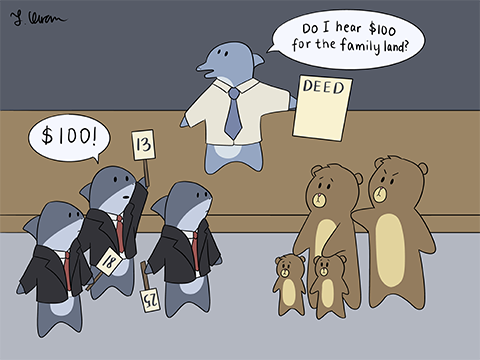
That changed in 2000 when Rivers learned that someone had filed a lawsuit called a “partition action” against him. An individual he never met—a distant relative who owned a fractional interest in the property—decided to sell their interest to a third-party investor. A court ordered the sale of the entire property, evicting Rivers and his family. The investor ultimately bought the property at a courthouse auction.
For Rivers, this outcome seemed impossible. But this practice is not an anomaly. It reflects a fundamental property law structure known as heirs’ property. This blog explores heirs’ property and how partition law, together with persistent access-to-justice barriers, drives involuntary land loss.
Defining Heirs’ Property
When someone dies without a will, the laws of intestacy govern distribution of their property. In almost every instance, when qualifying heirs survive an owner of real property, state intestacy laws require that those heirs own the property as tenants-in-common. This structure is often called “undivided ownership” because each tenant owns a fractional interest in the entire property, but not in any divisible “piece” of that property. Any tenant can unilaterally transfer their interest to a third party and, with it, the rights and responsibilities of undivided ownership.
This structure can become tenuous. If subsequent generations also die without wills, ownership continues to divide, and the number of co-owners grows. Eventually, dozens of people may come to own a single parcel of land.
Information thins out as ownership expands. Some heirs may live on the land. Others may not know they have an ownership interest at all. Worse, unless the heirs go to court to update the deed, there is no record accurately identifying each owner and their share. Researchers thus characterize heirs’ property as unstable. Hundreds of thousands of Americans hold property in this precarious state, and many may not realize just how tenuous their ownership is until they lose it.
Partition and Forced Sale
Partition law is supposed to resolve this fragmentation. Any co-owner—no matter how small their share—can file a lawsuit called a “partition action” asking the court to end the shared ownership. The court then has a choice: divide the land and allow each tenant to own a smaller parcel or sell the entire property at auction.
Courts frequently choose the latter. In a majority of states, courts employ an “economics-only test” to decide between physical division and a partition sale. This test asks only one question: can the court physically divide the land without compromising its economic value? If not, the court must order a sale. This test often results in a preference for sale. Economies of scale suggest that a single large parcel is more valuable than dozens of smaller parcels. The partition process thus often results in forced sales of family property, even if all other co-owners oppose the sale.
Partition actions create an opening for third parties to intervene in heirs’ property ownership. Because any co-tenant can force partition, speculators and developers may purchase an heir’s interest and then force a partition sale. To repeat, under the law of most states, it does not matter if that heir’s interest is one third or one three hundredth or one three millionth; the law operates the same way. At auction, the third party can then outbid the heirs and acquire the entire property for below its market value.
Partition actions are one of the leading causes of involuntary land loss. Researchers posit that heirs’ property has fueled a ninety percent decline in African-American land ownership since 1910.
Access-to-Justice Barriers in Partition
Partition actions present several access concerns. First, partition is litigation. Someone must appear to argue for alternatives to the sale. For heirs’ property owners, who tend to be “property rich and cash poor,” the cost of counsel can be prohibitive. Moreover, heirs’ property owners often lack alternatives to affordable legal services. While legal aid organizations can provide services at low cost, their reach is limited, particularly in rural areas where heirs’ property is most prevalent.
Families also raise concerns about notice. Some families claim that courts—rather than personally serving all co-tenants—often allow notice by publication in local newspapers. This method of service can prevent out-of-state tenants from receiving notice of the action. Even local heirs report notice problems. Some tenants claim that plaintiffs did not personally serve them even when the plaintiffs knew their addresses and how to locate them. These methods of service may violate the Constitution, but asserting such a theory requires litigation.
The partition auction itself also poses problems. While tenants receive a share of the sale’s proceeds, heirs’ property often sells for far below its market value. The aforementioned notice concerns sometimes mean that heirs who otherwise could have made competitive bids for the property at auction are unaware of their opportunities. Courts sometimes fail to advertise partition sales adequately. Courts may advertise partition auctions for as little as two weeks, while property owners list property on the open market for several weeks or months. Advertising exposes property to potential buyers and, in turn, a higher probable sale price.
Auction buyers must also purchase the property as is, without an inspection and subject to any defects in the title. These suboptimal conditions culminate in buyers paying nominal prices for heirs’ property at auction.
The Cost of Fixing Heirs’ Property
Proposed solutions to heirs’ property issues often assume access to legal services that many heirs do not have. Even basic estate planning can cost thousands of dollars in legal fees. Untangling title, for example, requires specialized legal counsel and the sometimes lengthy, costly task of tracking down all living heirs. One study estimated that resolving an unclear title in Philadelphia costs up to $9,200. For many heirs’ property owners, this cost can be insurmountable. Third-party developers, by contrast, “almost always have the ability to hire experienced lawyers.”
Heirs often lack basic information about their ownership and may believe “erroneous myths” that give them a “false sense of security.” For instance, one study found that 75 percent of heirs’ property owners erroneously believe that their property cannot be sold unless all owners unanimously consent to a sale. This lack of information might keep heirs from taking protective steps, like preparing wills or clearing title, even if they could otherwise afford to do so.
Reform Efforts and Their Limits
In response to these problems, lawmakers have begun to reform partition law. The most prominent effort is the Uniform Partition of Heirs Property Act (“UPHPA”), a model statute drafted in 2010 to curb forced sales. The Act introduces several procedural safeguards: courts must give heirs the opportunity to buy out the interest of the co-tenant seeking partition, considering the totality of the circumstances rather than an “economics-only” test. If the court orders a partition sale, they must sell the property on the open market rather than at auction. Roughly two dozen states have adopted the UPHPA.
The UPHPA leaves some concerns unaddressed. While the Act greatly improves process, heirs still must respond to litigation and, in many cases, marshal the resources to buy out another co-tenant’s share. Those steps often require counsel and access to capital, both of which remain out of reach for some heirs. Moreover, the Act operates only once a partition action is filed. It thus does little to address the upstream problems of tangled title, informational gaps, and lack of estate planning. In that sense, the UPHPA mitigates some of the worst outcomes of partition but does not resolve the conditions that produce them.
If you’re interested in more on this topic, listen to our podcast episode.