

By Michelle Blouin, Communications Associate, Access to Justice Lab, Harvard Law School
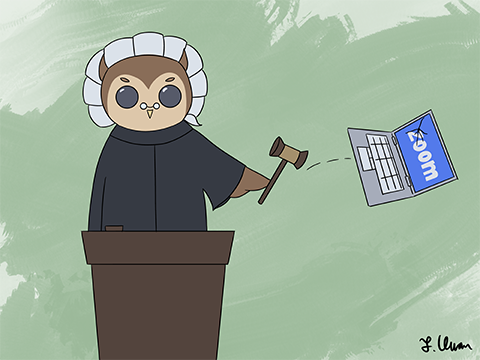
Which is better—in-person or virtual court hearings? That is the basic question at the heart of the Access to Justice Lab’s Online Courts study. The Lab sought to determine which mode helps courts most with lower failure-to-appear rates, shorter time to resolution, more durable court orders, and less court burden. We discuss the results, or lack thereof, of the Lab’s randomized controlled trial in next week’s Proof Over Precedent. Meanwhile, a partner researcher sought to assess a companion question, namely, which mode best helps self-represented litigants, with a qualitative study.
Most will remember that the Covid-19 pandemic thrust everything virtual into the mainstream. As the United States recovered from the pandemic, however, the question became whether to continue the then-current status quo of online interactions or whether to return to the pre-pandemic status quo of in-person interactions. The Third Judicial District Court in Utah (Salt Lake City), for example, wondered which worked better. Addressing the needs of its litigants in family law cases, specifically child custody and divorce cases, the Utah courts worked with Emily LaGratta, a justice reform consultant and founder of LaGratta Consulting, to conduct a qualitative study looking at perceived fairness in these cases.
“We’re pretty good at hearing from what judges want. Sometimes we hear from what the lawyers want,” LaGratta said in this week’s podcast episode. “But at the end of the day, we don’t really know if people feel like justice was done.”
The thought was that combining the A2J Lab’s quantitative data measuring court-based outcomes with LaGratta’s qualitative data measuring overall satisfaction would provide a more holistic view of online courts and facilitate determination of the most effective medium for court proceedings.
Measuring Fairness
Fair and trustworthy court experiences instill faith in the justice system and, more directly, contribute to the likelihood of a person following court orders, according to a 2023 report from the Maurer School of Law at Indiana University, “Accessing Justice with Zoom: Experiences and Outcomes in Online Civil Courts.” But with few studies examining virtual hearings for self-represented litigants, the few relevant articles point to litigants’ negative perception of fairness with online hearings but positive response to the ability to attend online proceedings. LaGratta worked with the Utah commissioners, who in turn worked with the bailiffs, to set up a survey system using an iPad kiosk at courtroom doors prompting in-person litigants to answer a few questions after their hearings. Study participants attending virtual hearings likewise received the same survey via email.
Survey questions looked at procedural justice through the lens of the litigants’ desire to be respected, to have a voice, to work with neutral and unbiased decision makers, and to receive help when needed. The questions included direct choice questions in addition to an open text field for additional feedback such as one litigant’s valid response, “Take a minute to let me respond.”
“I think at a minimum, we’re giving people a little dose of voice to give feedback about their experience, and the hope that there’s someone on the other end who’s going to take in that feedback and actually use it to inform policy and practice,” LaGratta said.
The A2J Lab’s RCT, which randomly assigned self-represented litigants to either in-person or remote hearings, ran alongside LaGratta’s qualitative study. Measurements on perceptions of fairness could also be linked to the mode of hearing.
The surveys had a response rate of 20 percent of litigants responding, split equally among mode of hearing. When asked, “Did the court treat me fairly today?”, most respondents, no matter the medium, answered positively. “That’s procedural justice at work,” LaGratta said, noting that the positive responses came even if the court did not side with the respondents in the hearing.
Online Deficiencies
Digging deeper into that question, however, revealed a bit of disparity between the two modes of hearing. Yes, overall, respondents on both sides answered that they received fair treatment in court, but just 65 percent of remote litigants answered favorably compared to the 84 percent of in-person litigants.
The shortfall in perceived fairness with online proceedings cannot yet be attributed to a particular factor, including technology access and socioeconomic inequalities, since the qualitative study did not look at causal effect. We can only speculate on points of frustration with online courts by comparing it to what we might experience in a typical Zoom meeting: speaking over one another, hesitancy with when to talk, lost connections, uncertain expectations on how to behave, etc. In a physical courtroom, the bailiff maintains order, provides instructions, and answers procedural questions. Without a virtual bailiff, who’s maintaining order in a remote courtroom?
Nathaniel Player, former director of the Utah State Court Self-Help Center and a partner in the Online Courts study, brought perspective on the courtroom comparisons. “It might be the case that [remote court] is not as fine-tuned as the thousand-year experiment that we’ve been perfecting…It’s not the case that you can just take [court proceedings] from one modality and put it into another modality.”
A Side Benefit
One bonus of the partnership between the participating Utah courts and the Access to Justice Lab is the benefit of knowledge sharing that courts don’t always get. Our access to data about the courts’ litigants on their pro se calendar gave the courts insight into the socio-economic communities they’re serving, which, for many self-representing individuals, tend to be low-income areas in Salt Lake City. This insight, coupled with a more people-focused mindset following the courtroom iPad reminders for litigant feedback, then led to a different project in which court services come directly to these communities. Just as remote hearings are showing, the court service may be more important than the courtroom itself.
The takeaway from the qualitative study is that a level playing field for online and in-person litigants will require more work. But a court experience that litigants view as fair is more likely to lead to cooperation. So, given the even split on preference for mode of appearance, it may be that the best—and fairest—answer to the question, “Which is better—in-person or virtual court hearings?” is “your choice.”
If you’re interested in more on this topic, listen to our corresponding Proof Over Precedent episode.
Look for next week’s Proof Over Precedent episode and blog, which will look at the quantitative results from the Online Courts study.