

By Rachel Barkin, J.D. candidate, Harvard Law School
STUDENT VOICES: The views expressed below are those of the student author and do not necessarily reflect the position of the Access to Justice Lab.
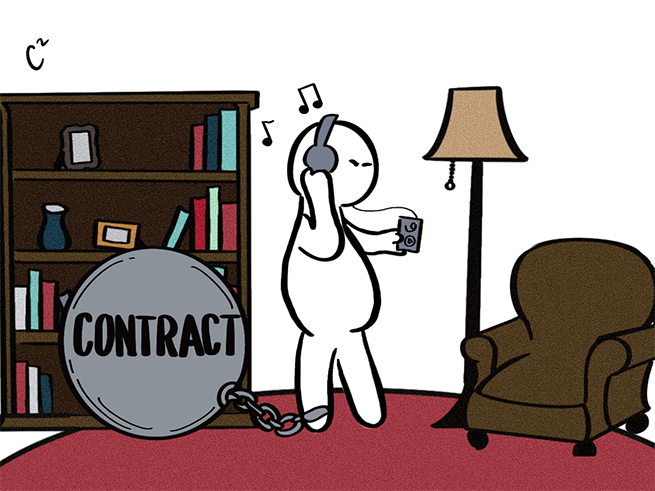
Did you know that when you created your Instagram account you agreed that Meta Products (Instagram’s parent company) and you would resolve disputes through arbitration, not court litigation? You also waived your right to participate in a class action, either in court or in arbitration. When you agreed to Instagram’s Terms and Conditions, you signed a mandatory arbitration clause with these terms.
A mandatory arbitration clause bars contracting parties from pursuing legal claims in court and instead requires them to pursue arbitration. Arbitrations are adversarial hearings that a private organization administers. The organization has a stable of adjudicators to preside, usually retired judges or attorneys. The decision is final and binding with limited opportunities to “appeal” (the technical term is to “vacate”). Terms of arbitrations vary, but many arbitration clauses prohibit juries. Other clauses set minimums or maximums on the damages award.
There is conflicting research on whether consumers who “agree” to mandatory arbitration clauses have worse outcomes compared to consumers who are free to litigate in courts. Courts typically assume that by entering a contract mandating arbitration, each party freely bargained for that clause. While there are concerns about how knowingly consumers agree to arbitration clauses, this blog post focuses only on consumers’ outcomes and possible future research.
There are reasons to worry that arbitration is less favorable to consumers. Unlike judges who receive salaries, arbitration services pay arbitrators per case. But in consumer contracts, the vendors (usually big companies) cover most or even all costs, so effectively, the vendors pay the judges. Sometimes, arbitration services randomly generate the list of arbitrators for each case and firms and consumers can strike arbitrators from the list. The firms often have more information about which arbitrators are more industry friendly. This asymmetry may lead to unfair advantages in the process of striking arbitrators from the lists until one is chosen.
Studies on Consumer Outcomes
- CFPB Study
In 2015, the Consumer Financial Protection Bureau (“CFPB”) conducted an empirical study on the effect of arbitration clauses on consumer financial disputes. The CFPB reviewed case records of 1,847 consumer financial disputes in the American Arbitration Association (“AAA”) from 2010 to 2012 regarding credit cards, checking accounts/debit cards, payday loans, prepaid cards, private student loans, and auto loans. Of these cases, 69.1% involved debt a consumer allegedly owed, while 59.8% involved a consumer claim. Attorneys almost always represented companies, and consumers had counsel in 60% of disputes.
The CFPB found that in disputes brought by companies, arbitrators granted financial relief to the companies in 93% of cases with an average award of $12,500. In actions brought by consumers, arbitrators provided those consumers financial relief in 20.3% of cases with an average award of $5,389. But it is not clear that cases initiated by companies versus consumers were similar. Meanwhile, there was little adjudication: in only a minority of cases (32.2%), the arbitrator resolved the dispute on the merits. In the remainder of cases, the CFPB found conclusive evidence of settlement (23.2%), likely settlement (34.2%), or termination without settlement (10.5%). When arbitrators did resolve cases on the merits, they were, in certain circumstances, more likely to award relief to consumers with attorneys. Again, the cases with attorneys may not have been similar to cases without attorneys.
There are different views on the implications of the CFPB’s study. Some people note that CFPB’s findings show that consumers in arbitration receive an average of $5,389 in relief compared to the average of $32 in class action lawsuits. Others point out that this comparison focuses only on the cases in which consumers win a claim in arbitration. They redirect focus on the fact that consumers win a lower percentage of cases compared to companies. Once again, cases subsumed in class actions are not necessarily comparable to successful arbitration disputes.
The CFPB study leads to various arguments in part because it does not have enough data to support a definitive conclusion. It is not clear from the study whether consumers received higher dollar amounts in settlements as compared to the arbitral awards (which CFPB acknowledges). It is interesting that consumers who used attorneys were more likely to reach a settlement as compared to consumers who did not use attorneys. Assuming for a moment that having an attorney is an advantage, would that suggest that settlement leads to better outcomes? But arbitrators awarded relief to consumers more frequently when they resolved their cases on the merits. Could that just be because their cases were stronger? The CFPB’s study is a great start but leaves open many questions.
- U.S. Chamber Institute for Legal Reform Study
In 2020, the U.S. Chamber Institute for Legal Reform found that consumers were more likely to win in arbitration (44%) compared to in court (30%). Consumers won more money in arbitration ($68,198) compared to in court ($57,285). The Chamber had downloaded data from 24,629 consumer arbitrations in the AAA and the Judicial Arbitration and Mediation Services (“JAMS”) and compared those cases to 76,615 federal court cases from 2014-2020.
This study has methodological shortcomings. The analysis excluded class actions, which might be the best option for consumers in court litigation. The Chamber’s research left unclear how much money consumers received in settlements. This study was not a randomized controlled trial (“RCT”) so the differences in outcomes could be due to factors other than adjudicatory setting.
- Colvin and Gough Study
In 2014, Alexander J.S. Colvin and Mark D. Gough found that employees in mandatory arbitration win less frequently and receive lower settlement amounts compared to employees in litigation. They analyzed 1,256 survey responses from attorneys representing employees in both forums about the outcomes of their cases.
From their sample, plaintiff employees won 46% of mandatory arbitration cases with an average of $362,390 in damages compared to 62% in litigation with an average of $676,688. 29% of settlements in mandatory arbitration fell between the range of $1 to $25,000 compared to 15% of settlements in federal court and 18% in state court. 23% of settlements in mandatory arbitration were above $100,000 compared to 43% in federal court and 38% in state court.
Colvin and Gough’s study is different from the two previous studies because they were able to collect data on settlement amounts. This approach provides a more accurate estimate of average financial outcomes.
The authors acknowledge some of their study’s limitations. First, while the cases in both forums had some similarities such as employer size and employees’ claims, the two case types differed in that the employees in mandatory arbitration tended to have higher salaries than those in litigation. Random assignment to arbitration or to court would have led to more reliable conclusions. Second, the study only included data on employees who had representation in both forums. On average, the attorneys said they charged $398 per hour or took on cases pro bono or with a contingent fee. This information may suggest that the study’s pool of cases might have been more meritorious or involved wealthier employees compared to the average consumer case. Therefore, these cases may not be generally reflective of consumer outcomes.
- Egan, Matvos, and Seru Study
In 2018, Mark Egan, Gregor Matvos, and Amit Seru found that industry-friendly arbitrators were 40% more likely to be chosen, which incentivized them to award consumers lower amounts. Running a regression, they estimated that industry-friendly arbitrators awarded customers 12% less money (about $90,000) compared to their more consumer-friendly colleagues.
While this study exposes procedural problems within arbitration, it cannot answer the question of whether consumer outcomes are necessarily better in court litigation. To accurately compare judges’ versus arbitrators’ treatment of consumers, cases would need to be randomly assigned to either court or arbitration.
Research Recommendations
Researchers interested in building off these studies could conduct RCTs. Here are some ideas:
- Some companies have contracts with an opt-out provision for arbitration. For example, Instagram allows users to “opt out of this provision within 30 days of the date that you agreed to these Terms.” A researcher could randomize a notification to consumers suggesting that they opt-out and track those cases over time. This type of study is called an “encouragement design”; it requires some fancy statistical techniques, but those techniques are well-articulated. To increase the amount of information they obtain, researchers can sign confidentiality agreements with consumers, allowing them to access settlement amounts while maintaining consumer privacy.
- In 2011, three scholars wrote an article recommending that governments gain knowledge by randomizing law itself and provided examples. For instance, in 2005-2007, the SEC conducted an RCT on short-sale restrictions to evaluate whether those restrictions improved the financial market. A researcher could design a similar study by working with a government agency (such as the CFPB, assuming it continues to exist) that might be able to exercise jurisdiction over arbitration. That agency could ban mandatory arbitration clauses but grant a temporary exemption for a random set of companies or contracts. One might pair this effort with letters notifying consumers of the inapplicability of the arbitration clauses. This approach may face legal challenges under the Federal Arbitration Act, but it is worth trying.
If you’re interested in more on this topic, listen to our Proof Over Precedent podcast episode.