
Jury

Cartoon depicting a dust bunny from "Death-Kwal Air Filter" handing out a jury slip to a worried individual trying to run away from it.

Are Death-Qualified Juries Qualified?

Jury selection should aim for a balanced and thoughtful panel; in capital cases, that balance is further underscored. This week’s “Student Voices” post argues that “death-qualifying juries”–the practice of excluding jurors who oppose the death penalty–disrupts that balance. Those constitutional guarantees of impartiality, equality, and reliability? Not so ensured with practice. Reform options, however, are not so simple.
Cartoon depicting a dust bunny from "Death-Kwal Air Filter" handing out a jury slip to a worried individual trying to run away from it.

Episode 67: Capital Jury Selection’s Hidden Biases

Serving as a juror fulfills one’s civic duty to ensure a system of checks and balances in the U.S. In capital cases, however, “death qualification” ensures that prospective jurors opposed to the death penalty will not have the opportunity to perform this civic duty. This week’s Proof Over Precedent episode features a “Student Voices” interview with Megan Byrne of the ACLU’s Capital Punishment Project to discuss the shortcomings of less diverse juries due to race, gender, and religious differences. It also looks at a capital case in Kansas in which the courts examined the problems associated with death qualification and the death penalty overall.

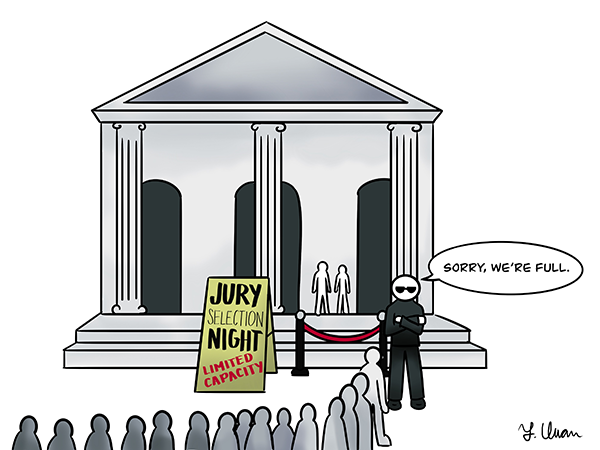
Cartoon depicting a line of potential jurors outside a courthouse with a sign saying the jury selection is at capacity (but only two jurors selected)

Randomizing Reforms to Ensure the Right to an Impartial Jury

The Sixth Amendment right to an impartial jury—particularly for Black defendants facing disproportionately white juries—isn’t always a guarantee. This “Student Voices” blog proposes three reforms to be randomized and studied in real courts, rather than assuming they work, to mitigate possible implicit racial bias in juries.

Scroll to Top