

By Kristen Arnold, J.D. candidate, Harvard Law School
STUDENT VOICES: The views expressed below are those of the student author and do not necessarily reflect the position of the Access to Justice Lab.
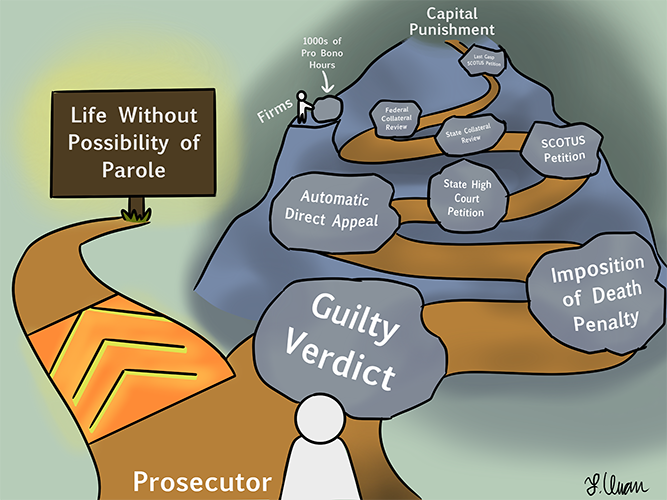
When you think of a hot button issue in the criminal legal system, what comes to mind? Probably mass incarceration, the war on drugs, and capital punishment. You are likely not thinking about life without the possibility of parole (LWOP). You should be.
Unlike capital punishment cases, defendants who face a maximum sentence of LWOP do not receive robust review of their sentence at the federal level (including all evidence submitted during trial and sentencing); automatic or mandatory appeals at the state level (see e.g., California, Florida, Nevada, Arizona, and Texas); a bifurcated trial with a jury determination of their sentence; or counsel for all stages of the criminal process (including discretionary appeals and collateral attacks). Further, non-profit organizations’ staff, and law firms dedicating pro bono hours, often provide counsel to assist those sentenced to death in federal habeas petitions. Meanwhile, those facing LWOP lack hope. They feel as though the system has left them behind to die in prison, and no one is fighting for them.
Life without Parole: Definitions & Eligibility
LWOP means that you are sentenced to remain in prison until death. Of LWOP prisoners, 87% die from illness, not natural causes, shedding some light on prison conditions that lifers face. This sentence makes one ineligible for review by a parole board and unable to seek relief through elderly parole or compassionate release. Some states, such as Alabama, do not review commutation petitions for LWOP: “life without parole in Alabama means just that—no parole, no commutation, no way out until the day you die, period.”
In some states, LWOP serves as an alternative sentence to capital punishment, and when defendants face a maximum sentence of the death penalty, LWOP is the only alternative that the jury can impose. Some states that have abolished the death penalty require that defendants convicted of certain crimes automatically receive LWOP. Specifics for eligibility vary by state, but most individuals serving LWOP have been convicted of murder. However, 37 states allow the imposition of LWOP after conviction for non-homicide offenses such as kidnapping, burglary, robbery, carjacking, and battery. LWOP can also be imposed for “serious habitual offenders.”
Death Penalty by Contrast: Crimes and Mistakes
Currently, capital punishment is only available for crimes involving death. Most of those sentenced to death have been convicted of first-degree murder or felony murder (accidental death during an intentional felony).
For capital cases, the rate of reversal of the death sentence is shocking. From 1973 to 1995, 41% of death sentences were thrown out on direct appeal, and 40% of those that survived direct appeal were overturned after federal habeas corpus review found “serious error.” In sum, less than a third of death sentences survived post-conviction litigation. The most common errors were egregiously incompetent lawyering or prosecutorial suppression of critical evidence.
Key Questions & Future Research
Is it possible that LWOP convictions have error rates similar to those of capital cases—errors not caught because of the lesser procedural safeguards placed on non-capital convictions? It is possible that death penalty cases do just inherently have a higher error rate, but there are reasons to be skeptical. Death penalty cases require two experienced trial attorneys who must know that the cases will generate increased media and pro-bono organization scrutiny. Both defense and prosecution counsel know that multiple avenues exist through which misconduct could be discovered, suggesting that both sides’ lawyers will take extra care. All this suggests that error rates in death penalty cases should be lower than in other case types. Of course, there are countervailing considerations. Perhaps courts treat the same errors in the trial proceeding differently depending on whether death or LWOP is the sentence, reversing in the former and affirming in the latter. And because some LWOP cases begin as cases in which prosecutors sought or threatened to seek the death penalty, at least some LWOP cases received the same scrutiny as capital cases, suggesting that their error rates would be similar. The point is: we do not know. Research might provide answers.
- Idea #1: A randomized control trial (RCT) testing the outcomes (e.g., error rates) between study-provided counsel and no study-provided counsel for those sentenced to LWOP.
Researchers could randomly assign those convicted of capital murder but sentenced to LWOP to either a study-provided counsel group or a no study-provided counsel group and compare the success rates of appeals against each other and against the capital murder death penalty cases in the same state or county (to assure the most accurate comparison). Note that field RCTs involving provision of counsel have occurred before in settings in which there was no right to a state-appointed lawyer.
- Idea #2: Compare states that do provide one automatic appeal and counsel for LWOP (e.g., California) to states that do not provide that support (e.g., Texas) and compare error rates, controlling for other relevant differences.
Certain states provide different protections as a matter state law, but there is no federal guarantee for LWOP unlike that of death penalty cases. If it is possible to control for relevant variables across states, researchers could compare outcomes of state-appointed counsel in one state against a state that does not provide counsel. This method would be cheaper than running an RCT as it would not require an intervention or hiring lawyers.
The Path Forward
If this research uncovers worrying error rates, we should work to improve procedural protections for those sentenced to LWOP, starting with mandating post-conviction counsel for direct discretionary appeals and collateral attacks. Costs will likely be a concern, but the studies recommended above should provide at least some ways to address budget concerns. In addition, if greater attention reveals that some LWOP defendants do not deserve lifetime incarceration, there should be cost savings associated with release from prison. Taking a data-driven approach should help.
Furthermore, courts should consider bifurcating trials when the maximum sentence is life without parole allowing juries to assess if a defendant should truly never be given the opportunity to return to society. The possibility of parole is not the guarantee of parole, but even the prospect of release would go a long way in preserving hope for defendants serving sentences without parole eligibility. Providing the possibility of parole would also allow the criminal legal system to accomplish rehabilitation by encouraging defendants to improve themselves to increase their odds when they come before a parole board.
The Supreme Court has given credence to the idea that “death is different” because of its severity, finality, and associated suffering, and the spectacle of the death penalty has led some abolitionists to begrudgingly support LWOP as a more humane alternative. But evidence is emerging that few of these rationales are true. Most LWOP inmates are not entitled to die in dignity or around family. They lack hope and often deteriorate mentally. They do not receive the same treatment and compassion as do capital defendants. We should reconsider whether ‘death is different’ through further research.
If you’re interested in more on this topic, listen to our Proof Over Precedent podcast episode.