Child welfare

Cartoon depicting a parent and child stuck on a life boat with the S.S. Courthouse boat nearby holding case storage and S.S. Resources boat holding everything the parent and child need (social work, financial help, etc.).

Navigating Unmet Social Needs: A Closer Look at New York Family Courts

In his 2026 State of the Judiciary Address, Hon. Rowan Wilson, Chief Judge of the New York Court of Appeals, took the opportunity to bring attention to one of the state’s most critical access to justice problems: the difficulties families face while navigating New York Family Court. Despite judicial efforts to address families’ underlying social needs, the legislative and executive branches of the state—and in the larger context, the nation—have the responsibility to implement more lasting improvements.


Cartoon depicts inmate waiting to be admitted into a virtual child welfare hearing

Locked Out: Structural Barriers to the Child Welfare System for Incarcerated Parents

For a child, parental incarceration is a legal gateway into the child welfare system. Parents have rights to participate in custody proceedings, but incarceration erects barriers that can make meaningful participation difficult. In this “Student Voices” post, we look at the current system–one in eight incarcerated parents lose their parental rights–and potential solutions to these barriers that, if left unchecked, can effectively lock incarcerated parents out of the child welfare process.

Cartoon depicts inmate waiting to be admitted into a virtual child welfare hearing

Episode 43: Navigating Child Custody Challenges From Behind Bars

This week’s “Student Voices” episode of Proof Over Precedent explores access to justice issues for incarcerated parents in the child welfare system. HLS student Mia Robertson looks at the process of removing a child from a home, working toward permanent placement and/or reunification, and the numerous barriers an incarcerated parent faces in custody cases, from an inability to show up for in-person hearings to a lack of reliable communication with an attorney (if they have counsel representation at all).

Cartoon depicting a mother and child on a stage between a bear representing Mother Up and holding cash out to them and a monkey representing Child Protection Services and being pulled off the stage.

Turning Proof into Policy: Evidence for Guaranteed Income to Support Black Mothers

The Mother Up project has grown from a small six-person study to the expanded and currently enrolling Phase III study now underway. Throughout, Mother’s Outreach Network has been building evidence to show that financial support, in addition to a network of social and legal help, can help Black mothers avoid entanglement with child welfare agencies. The leader of the organization offers her vision on the project and reaction to the results so far.

Cartoon depicting a mother and child on a stage between a bear representing Mother Up and holding cash out to them and a monkey representing Child Protection Services and being pulled off the stage.

Episode 42: Can Financial (and Other) Support Help Reduce Child Welfare Involvement in Neglect Cases?

This week, Proof Over Precedent speaks with Melody Webb, Founder and Executive Director of the Mother’s Outreach Network, a Washington, DC-based racial justice and anti-poverty organization that the Access to Justice Lab partnered with in its Mother Up pre-pilot study. Webb shares her vision for the study—which looks at providing Black indigent mothers with guaranteed income to support their children in an effort to reduce child welfare agency involvement—and offers perspective on the preliminary findings from the pilot.

Cartoon depicting Mothers Outreach Network (as a bear) giving money to a mother and child (drawn as horses) to buy (horse) shoes.

Episode 41: How Evidence-Based Research Could Transform the Child Welfare System

A2J Lab Director and Professor Jim Greiner sat down with five A2J Lab staff members to discuss “Mother Up”, a DC guaranteed income pre-pilot program with Mothers Outreach Network for Black mothers with recent CFSA involvement. The privately funded program explored how feasible it would be to conduct a larger study on the subject of guaranteed income, but this episode of Proof Over Precedent looks into why the Lab got involved with the program, how we gathered and analyzed data to apply to future evidence-leading studies, and what we’re seeing with results so far.

Cartoon depicting Mothers Outreach Network (as a bear) giving money to a mother and child (drawn as horses) to buy (horse) shoes.

Testing the Poverty-Child Welfare Connection: Pre-Pilot Study Explores Guaranteed Income

The “Mother Up” pre-pilot program is an evaluation of a guaranteed income project targeting Black mothers in Washington, DC, who are in danger of getting involved with the child welfare system. Studying the efficacy of the program provided the A2J Lab with enough solid data to pursue it on a larger scale and bring an evidence-based voice to the discussion on poverty’s link to child welfare.

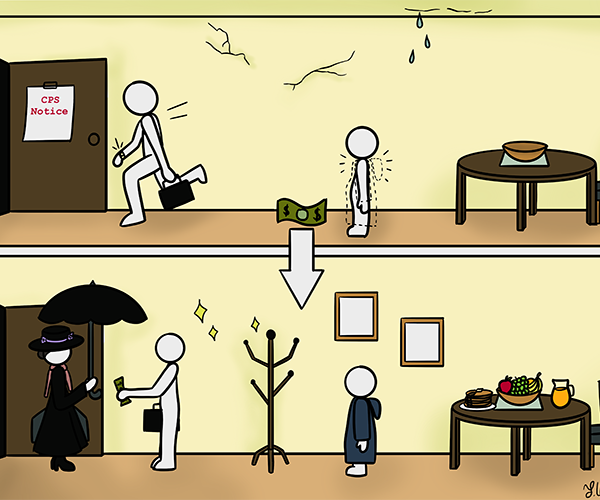
Cartoon comparing a household of neglect due to poverty vs. a household with a little more money running smoothly.

Episode 40: EmPwR Study–How Financial Support Means Family Support

The Empower Parents with Resources Study is the largest randomized control trial of the effect of unrestricted cash gifts on child maltreatment in the United States. Researchers aim to find out if a reduction in financial stress equals a reduction in child welfare involvement. In this week’s Proof Over Precedent episode, HLS J.D. candidate Julia Saltzman interviews researcher William Schneider, who explains the broad impact the study may have on families, caseworkers, and child welfare policy.

Cartoon comparing a household of neglect due to poverty vs. a household with a little more money running smoothly.

At the Poverty Line: Is Money the Root of Family Stability?

Eight hundred families in Illinois–and the researchers working with them–are about to find out. With monthly cash gifts of varying denominations dependent on family size and local cost of living, participants of the EmPwR Study will gain firsthand knowledge of whether a year of guaranteed income will stave off child welfare involvement. HLS J.D. candidate Julia Saltzman examines the relationship between poverty and family regulation system involvement and shares details on the randomized controlled trial taking place in urban, suburban, and rural communities in Illinois.

Scroll to Top