


Proof Over Precedent™ is a weekly podcast discussing the work of bringing credible evidence to lawyers, judges, and decision makers, to transform the U.S. justice system into an evidence-based field. Listeners will learn from one-on-one interviews with experts in the area of access to justice–researchers, lawyers, professors, law students, data analysts, research participants, and anyone who has an interesting role in this growing area.
Listen and subscribe on Apple Podcasts, Spotify, Amazon Music, iHeartRadio, and Pandora.

When the organized bar association faced financial strain during the Depression, it cracked down on low-cost legal service providers via auto clubs like AAA, contributing to today’s access-to-justice gap. In this “How did we get here?”-style episode, HLS student Andrew Reed interviews Stanford Professor Nora Freeman Engstrom and University of Chicago Fellow James Stone about their research and the “revolution” taking place in many states to reform the legal profession.

How likely would you be able to answer questions under duress seated in a hard chair in a windowless, flourescent-lit box of a room? What about in a larger space with natural lighting and comfortable seating? In this episode of Proof Over Precedent, HLS student Spencer Thieme discusses interrogation rooms and the effect of a physical environment on stress, memory, disclosure, and false confessions. She also considers potential randomized controlled trials for studying interrogation room design.

The role of trained nonlawyer volunteers is at the center of a back-and-forth court case between nonprofit Upsolve, Inc. and Letitia James, attorney general of the state of New York. This “Student Voices” episode tackles both the access to justice issues at stake for indigent defendants in debt collection cases, as well as New York’s unauthorized practice of law statute governing the decision(s), including the most recent ruling by the New York District Court in March.

In this week’s Proof Over Precedent episode, we look at civil forfeiture—law enforcement’s seizing and relinquishing of property based on probable cause in a criminal connection—and the impact it has on individuals, including innocent third-party owners. With no guaranteed right to counsel for these cases, most individuals never challenge forfeitures; the barriers are simply too high. Limited research means the practice of civil forfeiture is ripe for a study that goes beyond its impact on potential for future crime and expands to due process.

In this “Student Voices” episode, HLS J.D. candidate Matthew Hohmann interviews Hon. Rowan Wilson, Chief Judge of the New York Court of Appeals, about the challenges facing litigants in New York Family Court, a topic he focused on in his 2026 State of the Judiciary address. Hear about his holistic, long-range view in approaching family court cases.
This week’s “Student Voices” episode of Proof Over Precedent explores access to justice issues for incarcerated parents in the child welfare system. HLS student Mia Robertson looks at the process of removing a child from a home, working toward permanent placement and/or reunification, and the numerous barriers an incarcerated parent faces in custody cases, from an inability to show up for in-person hearings to a lack of reliable communication with an attorney (if they have counsel representation at all).

This week, Proof Over Precedent speaks with Melody Webb, Founder and Executive Director of the Mother’s Outreach Network, a Washington, DC-based racial justice and anti-poverty organization that the Access to Justice Lab partnered with in its Mother Up pre-pilot study. Webb shares her vision for the study—which looks at providing Black indigent mothers with guaranteed income to support their children in an effort to reduce child welfare agency involvement—and offers perspective on the preliminary findings from the pilot.

A2J Lab Director and Professor Jim Greiner sat down with five A2J Lab staff members to discuss “Mother Up”, a DC guaranteed income pre-pilot program with Mothers Outreach Network for Black mothers with recent CFSA involvement. The privately funded program explored how feasible it would be to conduct a larger study on the subject of guaranteed income, but this episode of Proof Over Precedent looks into why the Lab got involved with the program, how we gathered and analyzed data to apply to future evidence-leading studies, and what we’re seeing with results so far.

The Empower Parents with Resources Study is the largest randomized control trial of the effect of unrestricted cash gifts on child maltreatment in the United States. Researchers aim to find out if a reduction in financial stress equals a reduction in child welfare involvement. In this week’s Proof Over Precedent episode, HLS J.D. candidate Julia Saltzman interviews researcher William Schneider, who explains the broad impact the study may have on families, caseworkers, and child welfare policy.
If poverty can sometimes appear as neglect within a family, would better social and legal support help prevent unnecessary child welfare involvement? An Access to Justice Lab ongoing randomized controlled trial aims to find out. This episode gives a research partner’s point of view to the trial.
In this week’s Proof Over Precedent episode, HLS J.D. candidate Strong Ma discusses how public perceptions of fairness influence the adoption of AI and algorithms in medicine and law, two industries with varying levels of support and trust in AI. The podcast includes interviews with HLS Professors Jim Greiner and Jon Hanson weighing in on AI’s strengths and shortcomings in law, particularly as it compares to human decision making.
Is ending cash bail a path to a fairer justice system? California attempted this route in 2018 with its SB10, which would have ended cash bail statewide and replaced it with pretrial risk assessment. The effort could potentially have avoided a two-tiered, wealth-based system, but it fell short with voters. This “Student Voices” episode of Proof Over Precedent dives into the debate over cash bail, what went wrong with the SB 10 campaign, and lessons for future bail reform efforts.
This episode of Proof Over Precedent looks at predictive modeling research that could be used alongside policy research to answer the question, “What can we do to increase the number of criminal records cleared?” Researchers examined existing data on automatic record sealing in Pennsylvania and petition-based expungements in Kansas and adjusted criteria that could contribute to more effective record clearing. In the process, they made surprising discoveries on the state and future of criminal record clearances.
In this episode of Proof Over Precedent, the criminal record clearing process gets a close-up examination. Researchers and a former field partner at Kansas Legal Services discuss an expungement study in Kansas that reveals the numerous, and sometimes prohibitive and illogical, steps it takes for an individual to clear a record – a task made exponentially more difficult and less likely to succeed without the aid of legal representation.

Expungement appears to have all the signs of promising policy including better job and housing outcomes for individuals whose criminal records have been cleared; low recidivism rates; and subsequently better societal outcomes. Where it falls short, researchers in a Michigan study found, is with accessibility and uptake. This episode of “Proof Over Precedent” looks at the findings and dives into the challenges of studying expungement and the areas where the record-clearing process could be improved.
This episode of “Proof Over Precedent” brings together IRB Director Shannon Sewards and A2J Lab Faculty Director and podcast host Jim Greiner to talk about the complexity of ethical research involving incarcerated individuals and the balance between maintaining those ethical standards and advancing social and behavioral research. The discussion also delves into the differences between protections for biomedical research and those for behavioral research.
When it comes to consumer protection, signing off on the fine print may equate to signing off certain legal rights and agreeing not to sue a company in court but rather to use arbitration. Does the process actually matter? Several studies find variances in consumer financial relief and win rates, along with potential incentives in mandatory arbitration that could discredit the integrity of the process. The latest “Proof Over Precedent” episode calls for new research to address the shortcomings of existing studies and to provide definitive findings on mandatory arbitration’s impact on consumers.
In this “Student Voices” episode, HLS J.D. candidate Kristen Arnold looks at the procedural shortcomings of life sentences without the possibility of parole, particularly in comparison to capital punishment cases. She dives into the injustices of the LWOP procedure, the no-hope consequences for inmates and the system, and opportunity for a randomized control trial in the field to improve fairness.
Despite search warrants being a topic of significant interest in court cases and legal scholarship, the process of obtaining warrants offers comparatively little information. But when researchers found a surprising public data point in this field, their analysis led to sobering findings regarding the time judges spend reviewing warrants and the high approval rates of such warrants. In this episode of Proof Over Precedent, the researchers discuss their work, the data analysis process, and the implications of potentially insufficient judicial review of warrants.
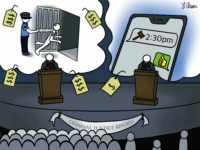
This Student Voices episode focuses on the data and studies pointing to the shortcomings of pretrial detention – the significant costs, lack of impact on reducing crime, and shortage of failure-to-appear connections. HLS JD candidate Leann Poarch instead suggests a low-cost, relatively low-tech alternative that may be more effective.